
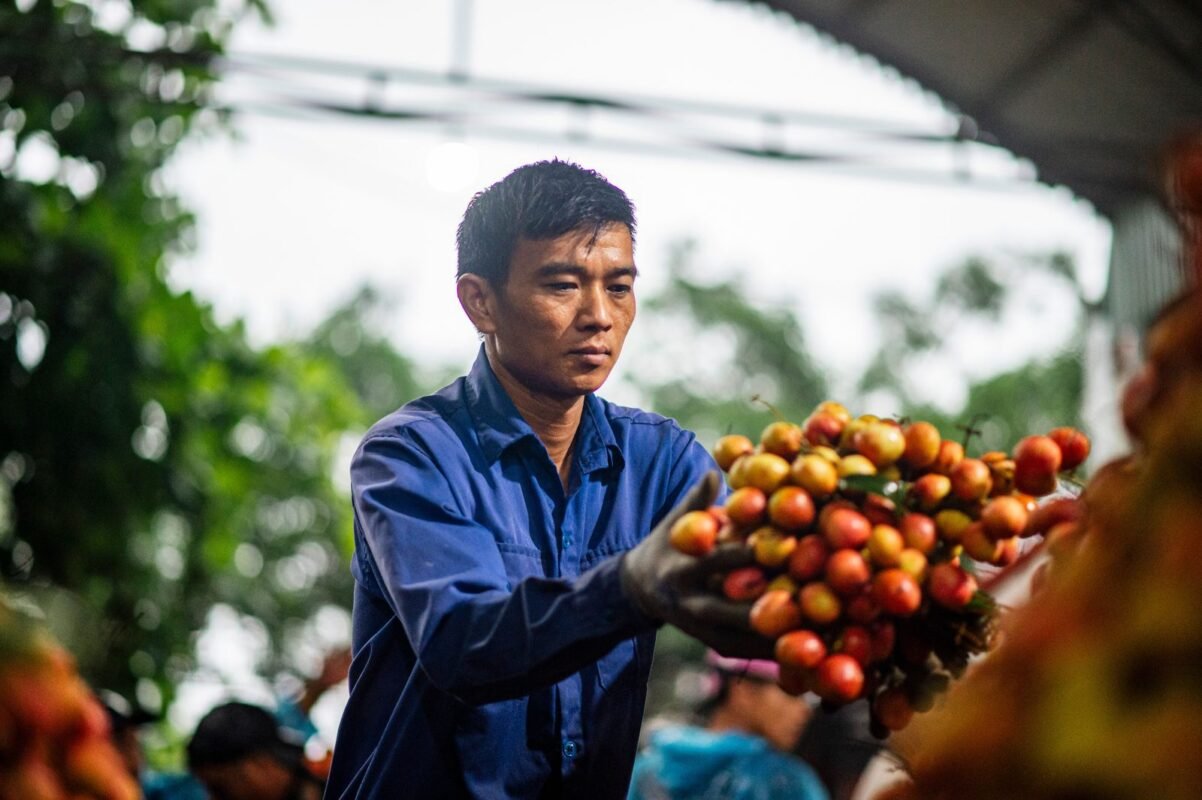
China is Vietnam’s largest agricultural export market (durian, dragon fruit, bananas, rice, cashews…) — but also its most demanding on standards. To export farm produce to China, businesses must pass three gates: orchard/packing-house codes managed by GACC (China’s General Administration of Customs), phytosanitary compliance under bilateral Protocols, and food safety (pesticide residues, heavy metals). This article sets out the complete standards for Vietnamese farm produce exported formally to China.
Gate 1: orchard and packing-house codes (GACC)
China’s General Administration of Customs (GACC) only permits imports from orchards and packing houses holding registered codes recognised by GACC. The process: (1) register with Vietnam’s Plant Protection Department; (2) meet GAP standards (VietGAP or GlobalGAP); (3) PPD inspects and issues the code; (4) the code list is sent to GACC for recognition. Key point: produce from uncoded orchards — however good — cannot formally enter China. Timeline: registration to GACC recognition takes 6–12 months (including China’s review). Trap: many traders buy from uncoded farmers then “borrow” codes from other orchards — when China traces (matching pack labels against records), the shipment is returned and the code suspended.
Gate 2: phytosanitary compliance under the Protocols
Each farm product exported to China is governed by its own Protocol on phytosanitary measures and food safety (durian, dragon fruit, bananas, jackfruit, rice… each with one). Common requirements: (1) freedom from China’s listed quarantine pests (pest lists differ by product); (2) quarantine treatment where the Protocol requires it (e.g. vapour heat treatment, irradiation, fumigation); (3) a Phytosanitary Certificate from the PPD for each consignment; (4) packaging and labelling as specified (orchard/packing-house codes, product name in Chinese/English). Reality: China randomly inspects at border gates — detecting pests or over-limit residues means the whole consignment is returned or destroyed, and the relevant codes may be suspended. One bad shipment can “kill” an entire code — which is why exporters must control quality from the orchard, not just at packing.
Gate 3: food safety — residues and heavy metals
China applies maximum residue limits (MRLs) for pesticides and heavy-metal limits (lead, cadmium…) on imported farm produce — stricter than Vietnamese standards. Three must-dos: (1) Manage pesticides from the orchard: only permitted-list chemicals, observing pre-harvest intervals (last spray to harvest) — the number-one cause of returned shipments (MRL breaches); (2) Pre-shipment testing: send samples to an accredited lab for pesticide-residue and heavy-metal testing before stuffing the container — testing (a few million dong per sample) is far cheaper than a returned container (hundreds of millions); (3) Traceability: keep cultivation logs (what was sprayed, when, what dose) per orchard — when incidents occur, trace to the exact plot and batch instead of losing the whole code.
Building a Vietnamese farm brand in China
Passing the three gates is only the “entry ticket” — selling at high prices, sustainably needs a brand. Reality: most Vietnamese produce enters China unbranded, in bulk — Vietnamese durian competes with Thai/Malaysian durian on low price, thin margins, and Chinese consumers don’t know they’re eating Vietnamese fruit. Three brand-building steps: (1) Register trademarks in China — through CNIPA, taking 12–18 months; don’t wait for a dispute (if someone registers first, you lose the brand); (2) Packaging and storytelling: invest in attractive packaging with QR traceability (scan to see the orchard and process) — China’s new-generation consumers pay premiums for traceable products; (3) Modern distribution: don’t sell only through wholesale markets (cheap, brandless) — get into supermarkets and e-commerce (Tmall, JD, Pinduoduo) where brands command pricing. Example: Thai Monthong durian sells in China 20–30% above Vietnamese durian — not because it’s clearly tastier, but because the Thai brand was built over 20 years. Vietnam can do the same — but must start now, because brands take 5–10 years to build.
Contracts with Chinese buyers — protecting the exporter
Many Vietnamese exporters sell to China on handshake terms — and learn the cost when disputes hit. Four protections: (1) Written contracts specifying quality standards (tied to the Protocol), inspection rights, and rejection procedures — vague “good quality” clauses invite rejection games at the border; (2) Payment terms: 30–50% deposit before shipment, balance on B/L copy or irrevocable L/C for new buyers — never ship a full container on open account to a buyer you’ve never met; (3) Governing law and dispute resolution: choose arbitration (e.g. VIAC in Vietnam) over Chinese courts for leverage balance — and specify it in the contract, not after the dispute; (4) Force majeure for border disruptions: when border gates jam or China suspends a code, who bears the demurrage and spoilage? Write it down before the trucks queue. Exporters with proper contracts don’t avoid all losses — but they cap them, while handshake exporters can lose an entire season’s profit on one bad deal.
From border trade to formal trade: the mandatory leap
Much Vietnamese produce reaches China via border trade (tiểu ngạch) — fast, cheap, light on paperwork. But: (1) border trade is unstable — gates open/close with policy; one control wave means thousands of trucks jammed; (2) China is tightening border trade, pushing flows into formal channels; (3) border-trade goods build no brand, selling 20–30% cheaper than formal-channel goods. Going formal requires: orchard/packing-house codes, formal export contracts, bank-settled payments, full phytosanitary compliance — costlier but stable, better-priced, and the only long-term path. Recommendation: businesses still 100% in border trade should start code registration today — the process takes 6–12 months; don’t wait for the gate to “close”.
Durian: the case study in how fast the rules move
Durian — Vietnam’s star fruit export to China — shows how quickly compliance requirements evolve. The pattern: when a product’s export value explodes, Chinese regulators tighten scrutiny — new testing requirements (e.g. for specific contaminants), stricter traceability, and sudden suspensions of non-compliant orchards/packers. Lessons for all exporters: (1) today’s compliant shipment is no guarantee for tomorrow — monitor GACC notices continuously (requirements change with 30–60 days’ notice, sometimes less); (2) the exporters who survive crackdowns are those with direct orchard relationships — traders buying spot from whoever’s cheapest can’t control quality when standards jump; (3) diversify markets — the US, EU, Japan and Middle East all buy Vietnamese fruit; over-dependence on China means one regulatory change wipes out the business. Durian’s boom-bust compliance cycles are a preview of what awaits every hot product — build the compliance system for the strictest plausible rules, not today’s.
Checklist: formal farm exports to China
1. Register orchard codes (PPD → GACC recognition, 6–12 months). 2. Register packing-house codes (up to standard, with QC). 3. Apply GAP (VietGAP/GlobalGAP) to orchards. 4. Read the product’s Protocol carefully. 5. Manage pesticides: permitted list + pre-harvest intervals. 6. Test residues/heavy metals before stuffing containers. 7. Phytosanitary Certificate per consignment. 8. Compliant packaging/labelling (codes, Chinese/English). 9. Full cultivation logs + traceability. 10. Formal contracts + bank settlement. 11. NEVER “borrow” codes — one bad shipment kills the code. 12. Monitor GACC notices — rules move fast.
Contact us
FLAT Law Firm advises Chinese investors in Vietnam across the full lifecycle: investment structuring, IRC/ERC procedures, tax, labour, intellectual property and dispute resolution. Contact us for advice tailored to your case.
This article has been quality-reviewed by the FLAW AI Legal Council
Related articles
- Cash Limits When a Chinese Investor Repatriates Capital
- Closing a Chinese Company's Representative Office When Leaving Vietnam
- Tax When a Chinese Investor Liquidates Industrial Park Land Lease Rights
- A Chinese Investor's Exit: Coordinating ODI Approval with NDRC
- Terminating a Project When NDRC Revokes a Chinese Investor's ODI Approval