
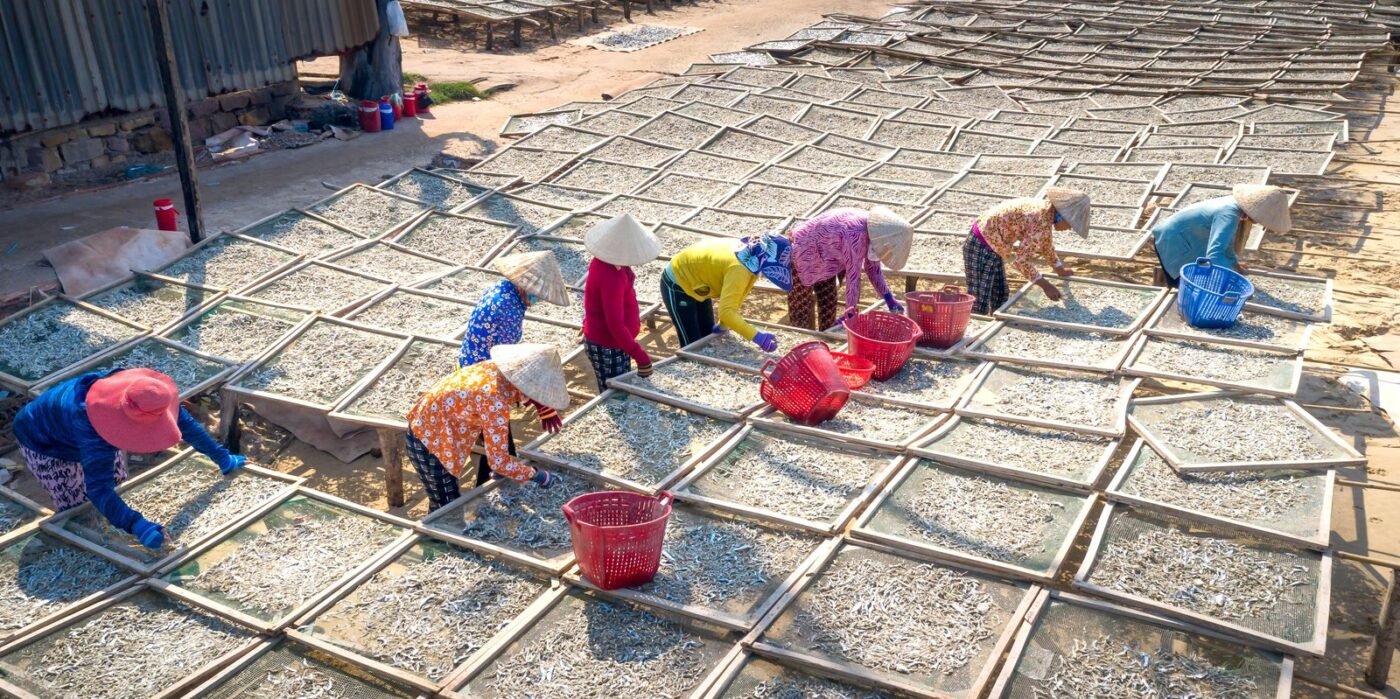
Food processing is the least noticed but most stable “China + 1” industry: no US tariff targeting, non-cyclical demand, and all three countries have abundant farm produce. But “having produce” doesn’t mean “can make export-grade food” — the gap is food safety, cold chains and certifications (Halal, HACCP, FDA). The three contenders — Vietnam, Thailand, Indonesia — each lead in different inputs: Vietnam in seafood and coffee, Thailand in rice, sugar and poultry, Indonesia in palm oil. This article scores the three on eight food-industry criteria.
Criteria 1–2: raw materials and food safety
(1) Raw-material base. Vietnam: seafood (shrimp, pangasius — world-leading exports), coffee (world No. 1 robusta), cashews, pepper, tropical fruit. Thailand: rice (famed hom mali), sugar, cassava, poultry, shrimp. Indonesia: palm oil (world No. 1), cocoa, coffee, seafood. Rule: processing plants belong near the raw material — hauling fresh produce far is costly and degrades quality. Scores (input diversity): 8/10 each — tied, but each wins different inputs.
(2) Food-safety systems. Exporting food to the US/EU/Japan demands HACCP, ISO 22000, plus market-specific rules (US FDA, EU regulations). Thailand has the oldest, most trusted food-control system of the three — “Thai Select” and Thai-GAP carry market confidence. Vietnam: the Food Safety Law 55/2010/QH12 and Decree 15/2018/ND-CP govern product declaration and production conditions; but EU RASFF alerts on Vietnamese seafood/produce still occur (antibiotic residues, pesticides). Indonesia’s system is still maturing, with lower credibility. Scores: Thailand 9/10, Vietnam 6/10, Indonesia 5/10.
Criteria 3–4: cold chains and deep processing
(3) Cold chain. Seafood, fruit and meat without a cold chain are waste. Thailand: the most developed cold chain (cold storage, reefer trucks, cold ports). Vietnam: developing fast but with breaks between smallholders and plants. Indonesia: the weakest — archipelagic, expensive cold logistics, high post-harvest losses. Scores: Thailand 9/10, Vietnam 7/10, Indonesia 5/10.
(4) Deep-processing capability. Raw exports earn thin margins; deep processing (canned goods, functional foods, extracts) captures value. Thailand: ASEAN’s most developed food-processing industry (CP Group and many internationally certified plants). Vietnam: shifting from raw to deep processing (instant coffee, ready-to-cook shrimp), but technology and brands remain weak. Indonesia: strong in refined palm oil, weaker elsewhere. Scores: Thailand 9/10, Vietnam 6/10, Indonesia 6/10.
Criteria 5–6: Halal certification and markets
(5) Halal certification. Muslim markets (Middle East, Malaysia, domestic Indonesia) require Halal — and Halal isn’t just “no pork”: entire lines, ingredients and additives must be certified. Indonesia: the world’s largest Muslim nation — mandatory Halal system (BPJPH); a plant in Indonesia does Halal most naturally. Malaysia is also strong (JAKIM). Thailand/Vietnam can do Halal but must build the system separately. Scores (for Halal markets): Indonesia 10/10, Thailand 6/10, Vietnam 6/10.
(6) Consumer markets. Indonesia: 280 million people — a giant domestic food market with a fast-growing middle class. Vietnam: 100 million people, a strong ready-processed-food trend. Thailand: 70 million + tourism (visitors consume heavily) + ASEAN export gateway. Scores: Indonesia 9/10, Vietnam 7/10, Thailand 7/10.
Criteria 7–8: cost and investor friendliness
(7) Production cost. Food processing is not labour-intensive like garments — the big costs are inputs + energy + cold logistics. Vietnam: cheap inputs, cheap power, cheap labour. Thailand: stable inputs, higher cost but lower quality risk. Indonesia: cheapest inputs (palm oil) but expensive cold logistics. Scores: Vietnam 8/10, Thailand 7/10, Indonesia 7/10.
(8) Friendliness to Chinese investors. Vietnam: a large Chinese business community in agro-processing (sourcing, processing), near the border — cross-border input sourcing is smooth. Thailand: good relations, a strong ethnic-Chinese food industry (CP Group has Chinese roots). Indonesia: more complex procedures, but an attractive market. Scores: Vietnam 8/10, Thailand 8/10, Indonesia 6/10.
Verdict: choose by input and market
Totals (out of 80): Thailand 60, Vietnam 57, Indonesia 56 — Thailand leads on food-safety systems and deep processing, but each country wins its own inputs. Processed seafood (shrimp, pangasius) → Vietnam (No. 1 inputs, ready processing clusters). Processed rice/sugar/poultry → Thailand (inputs + best systems). Palm oil and Halal products → Indonesia (no rival). Instant/deep-processed coffee → Vietnam (No. 1 robusta) or Thailand (processing technology). The industry’s rule: “inputs decide the location, certifications decide the market” — answer those two and the cost analysis becomes secondary arithmetic.
Three things to do before exporting food
(1) FDA registration (for the US). US-bound food facilities must register with the FDA and comply with FSMA (Food Safety Modernization Act) — prevention plans, traceability. (2) HACCP/ISO 22000 certification. The “entry ticket” to every developed market — build the system during plant design, never “build first, certify later”. (3) Residue control. Pesticides, antibiotics, heavy metals — one RASFF alert can trigger intensified checks on a whole country’s sector (Vietnamese seafood precedent). Build an in-house lab or contract an independent one, and test every incoming input lot.
Partnering for the last mile — brands and distribution
Processing capacity without market access is a stranded asset: the global food business runs on brands and retail listings, not factory output. Chinese investors have three routes: (1) OEM for global brands (lowest margin, but instant volume and the brand owner handles certifications and recalls); (2) acquiring a regional brand (Thai and Indonesian mid-size food brands trade at reasonable multiples and come with distribution); (3) building a China-facing brand (processing in Southeast Asia, selling into China’s premium import-food market — a large and growing channel). Distribution due diligence matters as much as plant due diligence: cold-chain distributors, modern-trade slotting terms, and e-commerce food channels each have their own economics. The most successful Chinese food investments in the region pair a Vietnamese/Thai plant (cost + inputs) with a Singaporean or Hong Kong trading arm (finance, branding, regional distribution) — manufacturing and market access engineered as one system, not two afterthoughts.
Checklist: siting a food-processing plant
1. Fix the core input: seafood, coffee, rice/sugar, palm oil — each has a different home. 2. Assess input distance: how far from growing regions? Is there a cold chain? 3. Check the food-safety system: credibility, alert precedents. 4. Define markets: US (FDA), EU (RASFF), Halal (BPJPH/JAKIM), or domestic — each needs its own certifications. 5. Assess deep-processing capability: technology partners available? Build or buy? 6. Model cost: inputs + energy + cold chain + certifications. 7. Survey existing processing clusters and packaging/additive suppliers. 8. Meet customers: what certifications do they require? 9. Take legal advice: product declaration (Decree 15/2018 in Vietnam), environmental licences. 10. Plan certifications (HACCP, Halal, FDA) in parallel with construction. 11. Secure distribution before scaling capacity — a plant without committed offtake is a liability, not an asset. 12. Insure the harvest risk: typhoons, droughts and disease wipe out input regions regularly — multi-region sourcing and crop insurance turn a catastrophe into a manageable variance. Map alternative growing regions for your core input before you need them — in a crisis, everyone chases the same backup suppliers. Sign framework agreements with backup growers in normal times — it costs little and pays enormously when the harvest fails.
Contact us
FLAT Law Firm advises Chinese investors in Vietnam across the full lifecycle: investment structuring, IRC/ERC procedures, tax, labour, intellectual property and dispute resolution. Contact us for advice tailored to your case.
This article has been quality-reviewed by the FLAW AI Legal Council
Related articles
- Utilities in Industrial Parks: China vs Vietnam — Price and Reliability
- Remaining Industrial Land in China vs Vietnam: Rental Price Trends
- Ready-Built Factory or Build on Leased Land in China? Compared With Vietnam
- Acquiring an Operating Company in China vs Vietnam: Approvals and Timeline
- After Incorporation in China: What Sub-Licenses Remain? Compared With Vietnam