

Commercial Disputes and Arbitration in Vietnam
Commercial disputes in Vietnam can arise from sale, processing, distribution, workshop lease, construction, M&A, labour, debt or cross-border contracts. For Chinese investors, Chinese-speaking investors and foreign investors, a dispute-handling strategy needs to combine commercial objectives, asset recovery prospects, partner relationships, contract terms, governing law, courts, arbitration and enforceability. In each specific dossier, note the post-merger court system under Resolution 81/2025/UBTVQH15, comprising 34 provincial People’s Courts and 355 regional People’s Courts; territorial jurisdiction over annulment of arbitral awards, bankruptcy, commercial business and intellectual property has been adjusted by Resolution 04/2026/UBTVQH16 (effective from 10/06/2026). FLAT LAW FIRM supports clients in assessing legal position, evidence, and suitable negotiation, arbitration or litigation options.
Assess evidence and dispute strategy
Commercial disputes and arbitration: who is this service for?
- FDI enterprises in contract, debt, delivery, quality or payment disputes.
- Chinese-speaking investors needing risk assessment before suing or being sued in Vietnam.
- Companies with unclear arbitration, court or governing law clauses.
- Buyers and sellers in M&A transactions with post-closing disputes.
- Enterprises needing asset recovery, debt collection or enforcement of awards.
Legal issues clients commonly face
Many disputes stall because contracts lack delivery and acceptance evidence, breach notices or clear dispute resolution clauses. Before filing suit, evidence and realistic objectives need review.
The choice between court and arbitration depends on the contract clause, dispute value, asset location, costs, time and enforceability. A wrongly written arbitration clause can spark jurisdictional arguments.
After the court system rearrangement, the old district-level People’s Court names should not be used by default for cases after 01/07/2025. The new jurisdiction must be checked at the time of filing.
Three things to do before deciding to sue
First, re-read the dispute resolution clause. It decides where the claim is filed, under which procedure and at what cost. A vague arbitration clause, one designating a non-existent centre, or one providing for both court and arbitration in parallel can cost many extra months just to resolve jurisdiction.
Second, check the limitation period. Limitation periods differ by type of relationship, and milestones such as the date the obligation arose, the date the right was known to be infringed, or the date a debt-reconciliation record was signed can all change how time is counted. This should be settled before investing time in preparing the file.
Third, assess realistic recovery. A judgment or award is only valuable if the respondent still has assets. That is why we usually review the asset position and consider interim measures from the preparation stage, rather than after the award is issued.
Negotiation is not a sign of weakness
Most commercial disputes end in settlement, not in an award. A tightly drafted demand letter, backed by an organised evidence file, often produces faster and cheaper results than suing immediately — especially where the parties still have a business relationship.
The condition for effective negotiation is that the demanding party is already ready for the litigation option. We usually prepare in parallel: one file for negotiation and one for filing suit, so switching to the second option costs no extra time if the counterparty drags things out.
What does FLAT LAW FIRM do?
- Assessing legal position, evidence, claims and counterclaim risks.
- Advising on negotiation, mediation, arbitration or litigation strategy.
- Drafting demand letters, breach notices, court or arbitration dossiers.
- Representing or supporting clients through the dispute resolution process.
- Advising on interim urgent measures, evidence preservation and asset recovery.
- Supporting recognition and enforcement of awards or dispute settlement agreements.
Implementation process
- Receiving contracts, evidence, the event timeline and the client’s commercial objectives.
- Reviewing dispute clauses, governing law, jurisdiction and limitation periods.
- Assessing strengths, weaknesses, negotiation prospects and enforceability.
- Proposing strategy and expected budget.
- Drafting dossiers and working with counterparties, arbitration or courts under authorization.
- Tracking enforcement and supporting post-dispute handling.
Documents clients should prepare
- Contracts, appendices, purchase orders, quotations and transaction terms.
- Delivery and acceptance documents, invoices, payments, shipping or warranty records.
- Emails, messages, meeting minutes, breach notices and demand letters.
- Counterparty information, address, assets, accounts or places of contract performance.
- Internal documents on damages, incurred costs and handling objectives.
- Existing awards, judgments or decisions where enforcement is needed.
Expected timeline
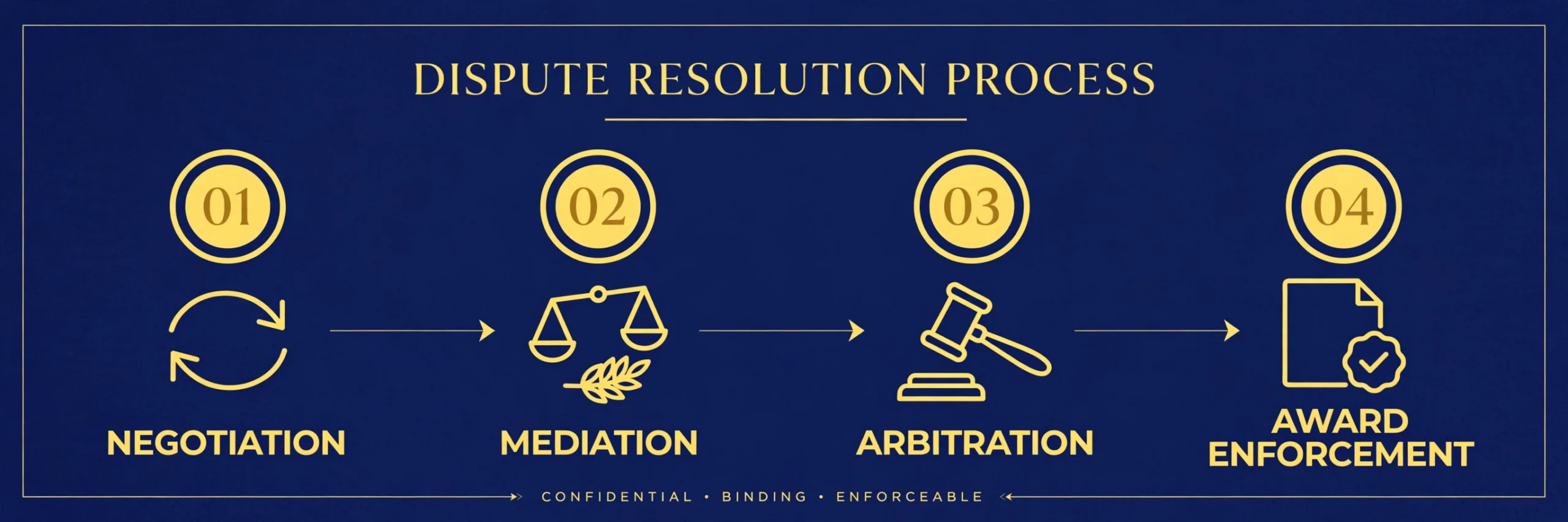
Dispute handling time depends on the negotiation strategy, the counterparty’s cooperation, the court or arbitration mechanism, evidence volume, expert assessment requirements and enforceability. Many cases should start with a quick assessment to avoid losing limitation periods or asset preservation opportunities.
Common legal risks
- Not sending breach notices properly or not preserving sufficient evidence.
- Filing in the wrong jurisdiction or using old court names after the system change.
- Invalid arbitration clauses or unclear arbitration centres.
- Compensation claims without evidence proving damages.
- Not checking assets, payment capacity and enforceability.
- Disputes disrupting commercial relationships without a communication strategy.
Reference legal framework
Commercial dispute resolution in Vietnam is governed by the Civil Procedure Code 2015 for court proceedings and the Law on Commercial Arbitration 2010 (No. 54/2010/QH12), in which the courts’ authority over arbitration activities under Article 7(3) was amended by Article 2 of Law No. 81/2025/QH15 (effective from 1 July 2025) under the new court model. The substance of disputes is further governed by the Civil Code 2015, the Commercial Law 2005 and sector-specific legislation. Information on arbitration procedural rules can be found at the Vietnam International Arbitration Centre (VIAC).
A note on jurisdiction: from 10 June 2026, Resolution 04/2026/UBTVQH16 (amending Resolution 81/2025/UBTVQH15) adjusts the territorial jurisdiction of courts for certain matters — including applications to set aside arbitral awards. When preparing a file, cross-check the rules in force to identify the competent court correctly.
Laws, the competence of state authorities and administrative procedures may change over time. The full texts of the instruments above can be looked up on the Government’s normative legal documents portal. The content on this page is for general guidance and should be cross-checked against the instruments in force at the time they are applied to each specific file.
Legal updates to September 2026
Resolution 81/2025/UBTVQH15 provides a new system of 34 provincial People’s Courts and 355 regional People’s Courts. Old district-level People’s Court names should not be used for content applying after 01/07/2025. Checks should follow the respondent’s address, the place of contract performance, the dispute resolution agreement and the new jurisdiction rules at the time of filing.
From 10/06/2026, Resolution 04/2026/UBTVQH16 (amending Resolution 81/2025/UBTVQH15) adjusts courts’ territorial jurisdiction over: requests for annulment of arbitral awards, bankruptcy, commercial business and intellectual property. When preparing to file suit or request annulment of an arbitral award, the competent court must be re-determined under the new rules rather than mechanically applying the old hierarchy.
The full text of the above instruments can be found at the Government’s system of normative legal documents. The content on this page should be checked against the instruments in force at the time of the procedure.
Why choose FLAT LAW FIRM?
FLAT LAW FIRM combines contract capability, dispute expertise and understanding of FDI enterprises. We help Chinese-speaking clients understand litigation risks in Vietnam in decision-ready language, while keeping the focus on recovery prospects and protecting commercial interests.
Frequently asked questions
Should we choose court or arbitration?
It depends on the contract clause, dispute type, value, asset location and enforceability. Review before sending the request.
Can we sue without a written contract?
Possibly if other evidence proves the transaction and obligations, but the risk level is higher.
Can debts be recovered with a lawyer’s letter before suing?
Yes. Demand letters or negotiation can resolve matters quickly, but must be written carefully so as not to affect legal position.
Is a Chinese-language arbitration clause usable in Vietnam?
The specific content needs checking: the arbitration centre, language, governing law and enforceability.
After the merger, how is the court determined?
Check by the respondent’s address, the place of contract performance, the dispute agreement and the new jurisdiction rules at the time of filing. From 10/06/2026, additionally apply Resolution 04/2026/UBTVQH16 on territorial jurisdiction over annulment of arbitral awards, bankruptcy, commercial business and intellectual property.
Can we apply for interim measures?
Yes, under certain conditions. Both courts and arbitration have mechanisms for interim measures — for example freezing accounts or seizing disputed assets. In arbitration, the tribunal applies them after it is constituted; before that point, a party may ask the court to apply them. The specific conditions and procedures should be checked against the procedural rules in force.
Does winning mean we get paid?
No. Enforceability must be assessed separately from the start.
Can a foreign company litigate in Vietnam?
Yes, depending on the contractual agreement, jurisdiction and the specific transaction structure.
You should talk to a lawyer if:
- The counterparty breaches payment, delivery or quality obligations and direct negotiation stalls.
- The contract’s dispute resolution clause is unclear (arbitration or court, which centre, governing law).
- Interim urgent measures are needed to preserve assets or evidence.
- You receive a request for annulment of an arbitral award or need to re-determine the competent court after the system change.
- There is an award or judgment needing recognition and enforcement in Vietnam or abroad.
- The dispute has foreign elements, bilingual contracts or multiple applicable laws.
- The limitation period is about to expire or evidence risks being scattered.
Assess Your Dispute Strategy
Send your existing documents, business objectives and expected timeline for our lawyers to review the next steps.
Phone: (+84) 988 424 851 | WhatsApp
Implementation timelines may vary by dossier, locality, competent authority and time of filing. The content on this website is for general information purposes only and does not replace legal advice for each specific case.
Legal regulations, state authority competences and administrative procedures may change over time, by locality and by dossier. You should consult a lawyer before making decisions or carrying out transactions.