
Scenario: a bank wants to open a branch inside an industrial park to serve enterprises and workers; another business wants a canteen and a mini-supermarket right inside the park. Both hit the same questions: how does service land inside an industrial park differ from production land — on rent, on purpose registration, on tax? This article analyses the regime for service and commercial land in industrial parks under the Land Law 31/2024/QH15 and Decree 35/2022/ND-CP.
Service land exists inside parks through the zoning mechanism
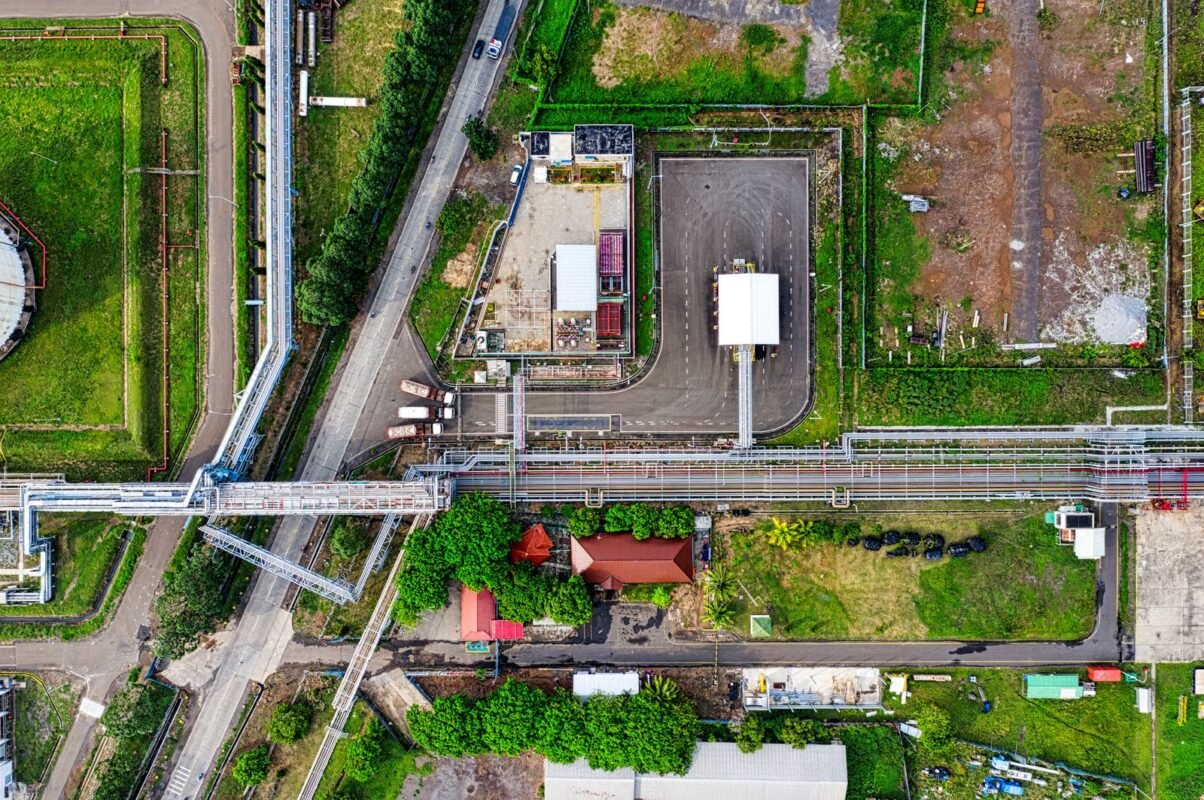
An industrial park is not a uniform block of production land: its detailed plan divides land into functional zones — factory land, service and administrative land serving the park, green land, transport land and technical infrastructure works. Facilities such as banks, post offices, canteens, mini-supermarkets and clinics belong to the service zone: they exist lawfully inside the park precisely because the plan reserved land for them, and they serve the whole park’s operation rather than “encroaching” on production land. The first legal consequence is that position decides validity: the same canteen activity is valid on a service-zone plot and a wrong-purpose land use on a production-zone plot leased out to the public. The second consequence is that the service purpose is recorded through the whole file chain: from the detailed plan, to the developer’s State land lease file (land rent priced by each zone’s purpose in the price list), to the premises sub-lease with the service investor.
Rent and cost: why service space is markedly more expensive
Three factors make service land cost different. One, the base land unit price: in the provincial land price list, commercial and service land carries a different and usually higher price level than industrial production land in the same area — the State land rent the developer pays for the service zone is therefore higher per square metre, and that cost passes into sub-lease rents. Two, the rent quotation unit: production land is quoted per hectare for long cycles, while service space is quoted per square metre of business floor with retail logic — the per-square-metre gap between the zones is very large. Three, planning scarcity: the service-land proportion in each park is locked by its approved detailed plan, supply does not stretch with demand, so service premises in filled parks usually command high rents and shorter offered terms than production land. Service investors must therefore price the deal on retail standards (customer traffic being the park’s workers and enterprises), not on industrial land-leasing standards.
Tax and operations for in-park service facilities
On tax, an in-park service facility is an ordinary business at a special location: value-added tax and corporate income tax follow its actual activities (catering services, retail, financial services by sector); the premises lessor has leasing revenue taxed like real-estate leasing activity. Land financial obligations towards the State remain in the park developer’s chain; the service facility signs no land lease with the State and does not directly pay land rent or non-agricultural land use tax for its floor area. On operations, the facility must meet its own sector’s conditions alongside park rules: canteens and collective kitchens serving workers must meet food safety conditions under current food safety law; bank branches need State Bank approvals as prescribed; every facility must comply with the park’s fire, environmental and hours rules. A final point to close when signing a service premises lease: the lease term must fit the remaining infrastructure project term and the current zoning plan — a planning adjustment shrinking the service zone can eliminate a well-running business location.
Frequently Asked Questions
Does land rent differ for service and commercial land inside an industrial park (banks, canteens)?
Yes, at all three layers: land price, rent and operations. On base land price: the developer’s State land rent is determined by each zone’s use purpose — commercial and service land in the price list carries a different (usually higher) unit price from industrial production land, so the root land cost of service land is higher and is reflected by the developer into service premises rents. On sub-lease rent: service premises rents inside a park are agreed market prices, usually quoted per square metre of commercial space and materially above production land rent quoted per hectare. On operations: service facilities (banks, supermarkets, canteens) must meet their own sector conditions (food safety for canteens, banking activity conditions for branches) and comply with the zoning plan — premises in a production zone do not automatically convert to service business use.
How is the land use purpose registered for service land inside an industrial park?
The service land use purpose is established at two layers. The planning layer: the park’s 1/500 detailed plan zones each plot by function — only a plot in the service/commercial zone is valid service land; using a production-zone plot for services requires a detailed-plan adjustment. The project layer: the service investor establishes an investment project (or obtains activity approval) at that exact position and purpose, signs a premises sub-lease or asset lease with the developer, and registers the corresponding business lines. For the developer, each zone’s use purpose is already recorded in its State land lease file — changing the service zone’s proportion or position amends the infrastructure project file, it is not an internal decision. For a factory wanting to open a canteen on part of its own land for internal service: a canteen serving the factory’s own workers is an auxiliary work within the production purpose, fundamentally different from servicing the public — this boundary decides whether a purpose split is needed.
How is tax handled when sub-leasing service premises?
Sub-leasing service premises is taxed like an ordinary asset-leasing and real-estate business activity: the lessor issues value-added tax invoices for premises rent at the rate applying to real-estate leasing (the standard 10%, except policy reduction periods), and pays corporate income tax on leasing profit; the service tenant books rent as a deductible expense with a valid contract and invoices where the lease serves its business. The underlying land obligations remain with the park developer towards the State (land rent by the zone’s purpose). One note on non-agricultural land use tax: land inside a park sits in the developer’s obligation chain with the State; a service facility renting premises does not become that tax’s payer merely by trading on the land.
Is there a cap on the proportion of service land inside an industrial park?
There is no single service-land percentage for all industrial parks in Decree 35/2022/ND-CP. The proportion of land for services, public utilities and other functional zones is fixed in each park’s approved 1/500 detailed plan, based on the park’s scale, sector orientation and the construction-planning standards applying to industrial parks (the land-use structure comprising factory land, service and administrative land, green land, transport and technical infrastructure land). The practical consequence: to know how much service land a park may arrange, read that park’s own approved detailed plan; and a developer wanting more service land than the plan allows must run a planning adjustment procedure — a real constraint that makes service premises in mature parks scarce and expensive.

