
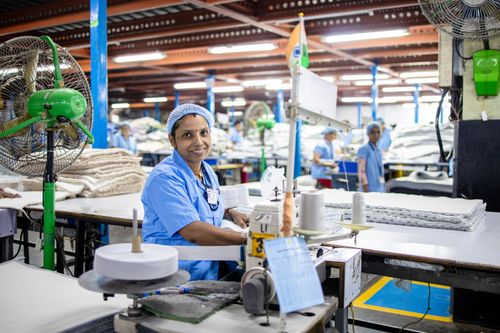
Photo: Pexels (free to use under the Pexels License)
Short answer: Vietnamese textiles claiming CPTPP preferences into Mexico must meet the “yarn-forward” rule in CPTPP Chapter 4: yarns and fabrics making up the product must, as a rule, be formed within member territories. Footwear (outside Chapter 4) follows the product-specific rules in Annex 3-D. Mexico has been a CPTPP member since 30 December 2018 and Vietnam since 14 January 2019 — and in the first seven months of 2025, Vietnam’s textile exports to Mexico reached USD 134 million. Getting origin right is what keeps that number growing without duty disputes.
1. Textiles: the “yarn-forward” rule in CPTPP Chapter 4
The yarn-forward principle. Under Article 4.2 and Annex 4-A, a textile product originates when every step from yarn onward — spinning, weaving/knitting, cutting and sewing — takes place in the territory of one or more CPTPP members. In practice: a Vietnamese producer importing yarn from China (a non-member) for weaving and sewing in Vietnam fails yarn-forward, even with 100% of cutting and sewing done locally.
De minimis tolerance of 10% (by weight). Textiles outside Chapters 61–63 with non-originating materials failing the tariff-shift rule still originate if those materials total no more than 10% of the good’s weight. For goods in Chapters 61–63, the 10% is measured against the weight of the component determining the tariff classification. One exception: elastomeric yarn in the classification-determining component must be wholly formed in member territories — no tolerance applies.
Short Supply List. 187 yarn/fabric lines may be sourced outside the CPTPP while keeping origin (8 temporary, 179 permanent) — a safety valve for inputs CPTPP members do not produce in sufficient quantity.
Three “cut-and-sew only” product groups. Handbags (HS 42.02), women’s brassieres (HS 6212.10) and children’s synthetic-fibre clothing (HS 6111.20, 6209.30) need only cutting and sewing in the CPTPP — far more flexible than yarn-forward.
Full cumulation. If the entire textile production process (fibre to yarn to fabric to garment) occurs in one or more member territories, the final product originates regardless of the origin of intermediate inputs along the way.
2. Footwear: the Annex 3-D rules
Footwear sits outside Chapter 4 and follows product-specific rules of origin (PSR) in CPTPP Annex 3-D: typically a change in tariff classification at chapter/heading level, sometimes combined with regional value content (RVC). Producers must look up the exact HS code of each shoe model — there is no single “footwear formula” like textiles’ yarn-forward.
3. Exporting to Mexico: practical points
Bilateral effectiveness. The CPTPP has applied to Mexico since 30 December 2018 and to Vietnam since 14 January 2019 — Vietnam–Mexico trade under the CPTPP has run smoothly for years.
Self-certification. Unlike the EVFTA (EUR.1 certificates issued by competent authorities), the CPTPP in Vietnam uses exporter self-certification under Circular 03/2019/TT-BCT. Exporters declare and bear responsibility for accuracy — so origin evidence (material norms, yarn/fabric purchase invoices, production records) must be archived for post-clearance audits.
The biggest risk: non-CPTPP inputs. Much of Vietnam’s textile yarn and fabric currently comes from China and Korea (Korea is not a CPTPP member). To earn preferences into Mexico, producers must shift yarn/fabric sourcing to CPTPP members (Japan, Malaysia, Australia, Mexico itself) or use the short supply list and the 10% tolerance.
4. Checklist for CPTPP textile and footwear exports to Mexico
- Classify the exact HS code of each exported item.
- Look up the matching origin rule: Chapter 4 + Annex 4-A (textiles) or Annex 3-D (footwear).
- Map material origins stage by stage: where each yarn/fabric comes from, and whether it is on the short supply list.
- Calculate the 10% weight tolerance for non-originating inputs.
- Prepare self-certification dossiers under Circular 03/2019/TT-BCT and retain them for post-clearance verification.
- For large orders, trial a small shipment and seek advice before committing to preferential duty with the Mexican buyer.
Frequently asked questions
What does “yarn-forward” mean?
Every textile production step from yarn onward (spinning, weaving/knitting, cutting, sewing) must occur in CPTPP member territories for the product to originate.
Does importing Chinese yarn for sewing in Vietnam earn CPTPP preferences into Mexico?
As a rule, no — it breaches yarn-forward (the yarn was not formed in the CPTPP), unless the yarn is on the short supply list or the non-originating yarn weight fits within the 10% tolerance.
Which rule applies to footwear under the CPTPP?
The product-specific rules in Annex 3-D (tariff-shift and/or regional value content), looked up by each shoe model’s HS code — Chapter 4 does not apply to footwear.
Is a certificate of origin needed for CPTPP exports to Mexico?
Not the authority-issued C/O model of the EVFTA. Vietnam applies exporter self-certification under Circular 03/2019/TT-BCT: exporters self-declare, bear responsibility, and keep dossiers for post-clearance checks.
How is the 10% textile tolerance calculated?
By weight: non-originating materials failing the tariff-shift rule must not exceed 10% of the good’s total weight (or 10% of the classification-determining component’s weight for Chapter 61–63 goods). Elastomeric yarn gets no tolerance.
This article has been quality-reviewed by the FLAW AI Legal Council
Related articles
- EVFTA and Vietnamese Steel: Self-Certification of Origin — Every Word Matters
- EVFTA and Vietnamese Footwear: Understanding the 10% Tolerance Trap
- UKVFTA and EU Material Cumulation: Correcting a Costly Misunderstanding
- EVFTA and Vietnamese Textiles: A 3-Step Formula for 0% Duty
- Vietnamese Solar Panels and US Duties: The AD/CVD and Circumvention Spiral