
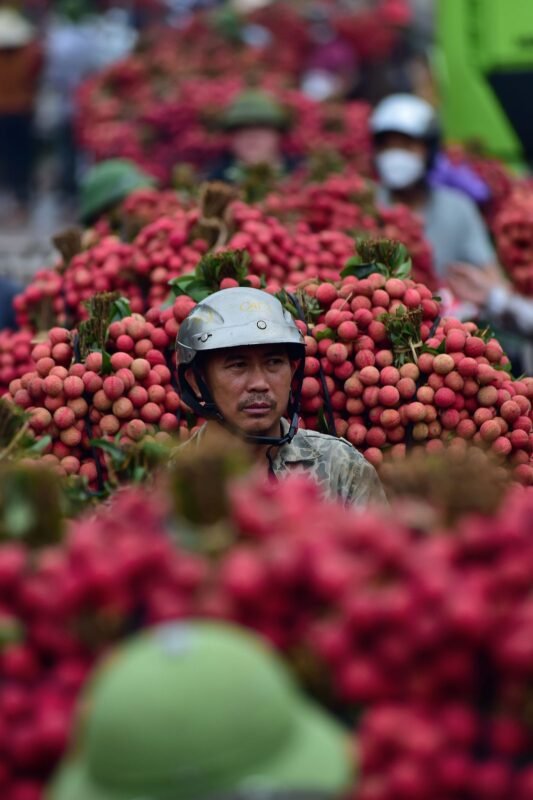
Lychee, longan and pepper are Vietnam’s “three spearheads” in farm exports — but each carries its own trade risk: lychee/longan depend almost entirely on China (one quarantine decision can strand a whole harvest), while pepper faces price competition from Brazil/Indonesia and rising technical barriers. This article analyses the anti-dumping/tariff and market risks of these three products — and how exporters defend.
Lychee and longan: the “single-market” risk
Lychee (Bac Giang, Hai Duong) and longan (Hung Yen, Son La) ship 70–80% to China — a huge advantage (big market, good in-season prices) and the biggest concentration risk. Three specific risks: (1) Sudden quarantine risk: China can suspend codes on pest detection — lychee/longan are fresh, highly perishable (days of shelf life); a mid-season suspension means thousands of tonnes rotting; (2) “Border closure” risk: as analysed in our farm-export overview — border jams during lychee season (June–July) are annual; (3) Price risk: in bumper years (output up 30–50%), farm-gate prices can halve — farmers and buying traders both lose. Defences: (1) diversify markets — Vietnamese lychee/longan already reach the US, EU, Japan, Australia (small volumes so far) — each new market is a safety valve; (2) deep processing — dried, canned, juiced lychee/longan keep longer, escaping the race to push fresh fruit across the border in days; (3) farmer offtake contracts (floor prices) + export contracts with border force-majeure clauses.
Pepper: the price war and technical barriers
Vietnam is the world’s largest pepper exporter — but the position is under challenge. Risk 1 — price competition: Brazil and Indonesia are expanding pepper acreage; Brazilian pepper typically runs 10–15% cheaper than Vietnam’s — importers (US, EU, India) squeeze Vietnamese prices down. Risk 2 — technical barriers: the EU is tightening pesticide MRLs on imported pepper; non-compliant consignments get returned — testing and orchard-management costs rise. Risk 3 — trade defence: some markets have applied or threatened defence measures on pepper (AD duties, safeguards) — exporters must track proceedings and prepare response files. Defences: (1) raise quality (clean pepper meeting EU MRLs) to sell above Brazilian prices instead of racing down; (2) deep processing (ground pepper, organic, extracts) — margins 2–3× raw pepper; (3) diversify markets (Middle East, Eastern Europe) to cut dependence on 2–3 big buyers.
Bac Giang lychee: the formal-export playbook
Bac Giang is Vietnam’s lychee capital — and the pioneer in moving from border trade to formal channels. Lesson 1 — orchard codes are “assets”: cooperatives in Luc Ngan (Bac Giang) registered orchard codes early, meeting VietGAP/GlobalGAP — when China tightened quarantine, their goods kept moving while uncoded shipments jammed at the border. Lesson 2 — processing extends “shelf life”: dried Luc Ngan lychee sells year-round at stable prices 3–4× fresh in-season lychee (per kg) — and reaches demanding markets (Japan, EU) that fresh lychee struggles to enter. Lesson 3 — the “four-house” linkage: farmers (growing) + scientists (varieties, technique) + businesses (buying, processing) + government (codes, promotion) — this model synchronises quality across a region instead of every household doing its own thing. The number: formal-channel lychee to China fetches 20–30% more than border-trade lychee — enough to cover codes, quarantine and still profit. Conclusion: Bac Giang’s path is the map for Hung Yen/Son La longan and every farm product wanting to “go big” — formal channels + codes + processing.
Vietnamese vs Brazilian pepper: the detailed comparison
(1) Scale: Vietnam ~130,000 ha; Brazil ~40,000 ha but growing fast — Brazil is the rising challenger. (2) Price: Brazilian pepper runs 10–15% cheaper thanks to vast land and higher mechanisation — Vietnam grows largely by hand, with higher labour costs. (3) Quality: Vietnamese pepper (especially Phu Quoc, Binh Phuoc) is rated more aromatic and pungent — the only lever for premium pricing. (4) Processing: both countries export mostly raw pepper — whoever moves first into deep processing (organic pepper, piperine extracts) escapes the price war. Strategy for Vietnam: don’t try beating Brazil on price (unwinnable — their land is vaster, their machines more numerous) — win on quality + processing + brand (“Phu Quoc pepper” could become a geographical brand like Cambodia’s “Kampot pepper”, selling at 3–5× ordinary pepper). The Kampot lesson: Cambodia — a small pepper exporter — sells Kampot pepper (geographical indication, organic) at USD 50–100/kg versus USD 3–5/kg for ordinary pepper. Vietnam has everything needed to do the same with Phu Quoc pepper — except someone doing it. The same logic applies to lychee and longan: origin branding (“Luc Ngan lychee”, “Hung Yen longan”) turns a commodity into a label consumers ask for by name — and labels, unlike harvests, don’t rot in a border jam.
Common risk: price volatility and contracts
All three are commodities — prices swing hard with seasons, weather and import policy. Four contract rules: (1) export contracts need flexible pricing (market-reference price + band) or fixed prices with deposits — never sign fixed prices without deposits in volatile markets; (2) force majeure covering border closures and code suspensions; (3) quality-inspection clauses — who inspects, where, to what standard (preventing “substandard goods” disputes when prices fall and buyers want out); (4) payment: irrevocable L/C for big orders, 30% deposits for new ones. Principle: when prices rise, sellers want to break contracts for higher prices; when they fall, buyers want to walk away — a good contract holds both sides when markets turn.
Hedging the harvest — financial defences
Contracts allocate risk; finance absorbs it. Four financial defences: (1) Don’t pre-finance the whole season — traders who advance farmers 100% of expected harvest value go bankrupt when prices halve; cap advances at 50–60% with the balance on delivery; (2) stagger sales — selling the entire harvest in one week locks in whatever the market offers that week; phased selling across the season averages out spikes and crashes; (3) use cold storage strategically — lychee/longan keep only days fresh, but dried/frozen product keeps months; investing in drying/freezing capacity turns a perishable gamble into inventory you control; (4) keep a war chest — retain profits from good years to survive bad ones; the exporters who die are rarely the unprofitable — they’re the illiquid, killed by one bad season’s cash-flow crunch. Commodity exporting is risk management with a trading desk attached, not the reverse.
Checklist: risk defences for lychee/longan/pepper
1. Diversify markets — never depend >60% on one market. 2. Orchard/packing codes complete, quality maintained. 3. Deep processing (dried, canned, ground) — cut fresh-fruit dependence. 4. Manage pesticide residues (meet EU MRLs — the strictest). 5. Contracts with flexible pricing + border force-majeure. 6. L/C payment or 30% deposits. 7. Track trade-defence proceedings in import markets. 8. Build brands — premium pricing over price wars. 9. Financial reserves for 1–2 hard seasons. 10. Full export cargo insurance. 11. Cap farmer advances at 50–60%. 12. Stagger sales across the season.
Contact us
FLAT Law Firm advises Chinese investors in Vietnam across the full lifecycle: investment structuring, IRC/ERC procedures, tax, labour, intellectual property and dispute resolution. Contact us for advice tailored to your case.
This article has been quality-reviewed by the FLAW AI Legal Council


