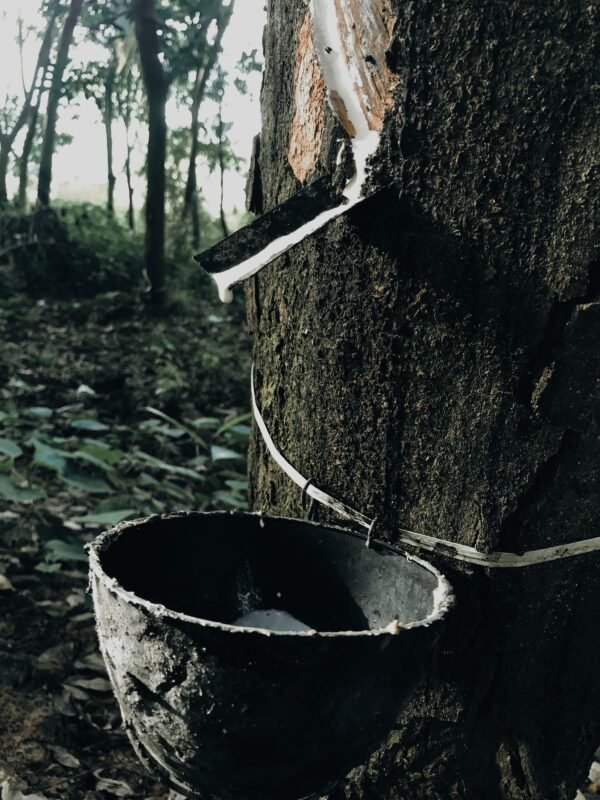
The direct answer: natural rubber is one of seven commodities under the EU Deforestation Regulation (EUDR — Regulation (EU) 2023/1115) subject to the strictest controls. Natural rubber (HS 4001, from Hevea brasiliensis) faces full due diligence: businesses must prove the rubber did not come from land deforested after 31 December 2020, was produced legally under the producing country’s laws, and must supply plot-level geolocation in a Due Diligence Statement filed on the EU Information System before the goods are placed on the market. Application dates after the latest adjustment package: 30 December 2026 for large operators, 30 June 2027 for SMEs. Vietnam is a major natural-rubber exporter to the EU — and with tens of thousands of smallholder rubber farmers, “plot-level mapping” is a genuine challenge.
Scope: HS 4001 and derived rubber products
EUDR Annex I lists natural rubber under HS 4001 (latex, smoked sheets, TSR and the like) as a mandatory-scope commodity — requiring plot-level geolocation. Processed rubber products are also covered, marked “ex” (extract) before the HS code: compounded rubber (ex 4005), tyres (ex 4011 — a primary focus of 2026 port audits), rubber gloves (ex 4015) and other industrial articles (ex 4016). The key distinction: only NATURAL rubber from Hevea brasiliensis is covered — SYNTHETIC rubber from petrochemicals (HS 4002) is exempt as deforestation-irrelevant; tyres made purely of synthetic rubber are likewise out. A draft simplification delegated act proposes exempting used rubber products, waste, negligible-value samples and packaging — but it remains a draft, so businesses should watch the official text. For Vietnamese exporters, step one is HS screening of every product line: a single natural-rubber component in an “ex”-listed product pulls the whole consignment into due diligence.
Three due-diligence pillars: deforestation-free, legal, traceable
Pillar one — deforestation-free: rubber must be produced on land not deforested after 31 December 2020, evidenced by satellite data and plot coordinates. For Vietnam’s smallholder rubber, this is the hardest part: thousands of fragmented small farms, many without digitised cadastral maps — collectors must survey and geolocate each supplying household. Pillar two — legality: production must comply with the producing country’s laws on land-use rights, environmental protection, labour rights and tax. Pillar three — traceability and declaration: the EU importer (operator) files the Due Diligence Statement on the EU Information System before placing goods on the market; Vietnamese exporters do not file directly but must supply the full traceability dataset to their partners — no data, no customs clearance. Penalties are severe: fines, confiscation and exclusion from EU public procurement.
Action plan for Vietnamese rubber businesses
With deadlines of 30 December 2026 (large firms) and 30 June 2027 (SMEs), Vietnamese rubber businesses should act now in four steps. Step one, risk classification: determine the producing country’s benchmarking category — the depth of due diligence (simplified vs full) depends on it, though geolocation and declaration apply in all cases. Step two, build traceability: map the sourcing area, geolocate every plot and supplying household, keep consignment-level records — an investment that cannot wait, since smallholder data collection takes months. Step three, legality review: check land papers and environmental permits across the sourcing area. Step four, coordinate with EU importers: agree data formats and trial-file the Due Diligence Statement on the EU Information System before the deadline. Experience from coffee (also EUDR-covered) shows early traceability preparation turns the barrier into a competitive edge — EU importers will favour suppliers already “EUDR-ready”.
Frequently asked questions
- Is synthetic rubber covered by the EUDR?
- No. Only natural rubber from Hevea brasiliensis (HS 4001) is covered; petrochemical-based synthetic rubber (HS 4002) is exempt as deforestation-irrelevant.
- What are the EUDR application dates for rubber?
- 30 December 2026 for large operators and 30 June 2027 for SMEs, under the application timetable following the latest adjustment package.
- Must Vietnamese exporters file the Due Diligence Statement directly?
- No — the EU importer (operator) files it on the EU Information System. But Vietnamese exporters must supply the full traceability dataset (plot coordinates, legality evidence); without it, goods cannot clear customs.
- What is the “deforestation-free” cut-off date?
- Rubber must be produced on land not deforested after 31 December 2020, evidenced by satellite data and plot-level geolocation.