
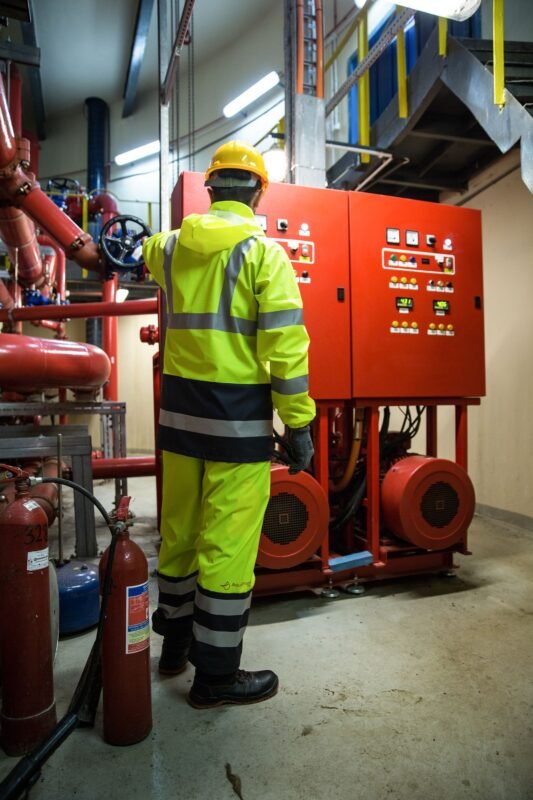
An EV charging station or a battery storage hall looks calmer than a chemical plant, yet a lithium battery fire is among the hardest fires in new energy projects: it starts inside a cell, generates its own heat, and can reignite hours after surface flames die down. Fire safety therefore has to be designed from the first drawing, not bolted on at acceptance stage.
Where the project sits in the current fire safety framework
The Law on Fire Prevention, Fighting and Rescue 55/2024/QH15, effective 1 July 2025, together with Decree 105/2025/ND-CP, frames every energy project involving construction. At the time of writing Vietnam has no national technical regulation dedicated to EV charging stations, so projects are assessed under the general frame: fire hazard classification of the works by materials and on-site storage function, design appraisal for items on the appraisal list, and fire safety acceptance before operations begin. The quantity of batteries stored on site is the decisive variable: a charging station with cabinets and a small buffer battery lives in a different requirement tier from a container-scale battery warehouse or a pack assembly plant.
Investors should lock three documents at basic design stage: a fire hazard classification note that models a battery fire scenario, the fire design appraisal file for the relevant items, and an acceptance plan with a firefighting method statement agreed with the fire police. Those same three documents are what a landlord, a lender and an insurer will ask for first when the project enters their own appraisal rounds.
Designing against lithium battery fires: contain, detect early, cool for long
Unlike an ordinary fire, a lithium battery incident starts with self-heating inside one cell, releasing flammable gas and cascading into neighbouring cells in the domino pattern known as thermal runaway. Design therefore turns on three layers. The containment layer splits battery storage into independent fire compartments with fire-rated walls and doors, keeps separation between rack rows or battery containers, and never stores batteries in the same compartment as other flammables. The detection layer places heat, smoke and gas sensors in each compartment wired to a staffed alarm centre, because the effective response window is measured in the first minutes after a module starts overheating. The suppression layer prioritises sustained water cooling at sufficient flow and duration to pull the temperature of the whole battery mass down, rather than knocking down surface flames and letting the pack reignite overnight.
Two operational details are often missing from design files: fire appliance access right up to the battery compartment and a dedicated on-site firefighting water reserve. A charging station in a shopping centre basement or a battery hall deep inside a leased factory must answer both questions with drawings and figures, not general assurances. Defective, quarantined and warranty-returned batteries need their own outdoor isolation area or separate fire-rated compartment, because they carry the highest incident probability in the project life cycle.
Operations, insurance and responsibility once an incident happens
After acceptance, the fire duty becomes an operating duty: maintain a trained on-site fire team, drill a battery fire scenario, test detection and suppression systems on schedule, and log charging cycles and temperature anomalies for each storage system. When an incident occurs, both law and common sense put people first: isolate power to the area, evacuate, call the professional fire service, and keep staff out of the battery compartment until firefighters confirm safety, because vented battery gas is toxic and a pack can reignite hours after it appears cold.
On insurance, facilities listed in Appendix VII of Decree 105/2025/ND-CP must hold compulsory fire and explosion cover for their assets; beyond the compulsory layer, battery and charging projects should add extended property cover and third-party liability, because damage spreading to the landlord premises and to customer vehicles on charge is the largest post-fire dispute at a charging station. Declaring the true stored battery capacity when buying cover is what prevents an indemnity cut for under-disclosed risk.
Frequently Asked Questions
What fire safety requirements apply to EV charging stations?
A charging station must satisfy the general frame of the Law on Fire Prevention, Fighting and Rescue 55/2024/QH15 and Decree 105/2025/ND-CP: items on the appraisal list need fire design appraisal and acceptance before operation, with safe distances, appliance access, alarm systems and firefighting means matched to scale. No dedicated national regulation for EV charging stations exists at the time of writing, so the concrete requirement level is set through the project appraisal file, where the amount of battery storage on site is decisive.
What fire safety requirements apply to battery storage warehouses?
Lithium battery storage must be designed around fire spread control: independent fire compartments with rated construction, separation between battery rows, heat, smoke and gas detection in each compartment connected to the alarm centre, and sustained water cooling long enough to bring the whole battery mass down in temperature during a self-heating event. Defective and returned batteries belong in a separate isolation area. The battery hall design falls within fire design appraisal and acceptance before use.
How should a lithium battery fire be handled?
A lithium battery fire starts with self-heating inside a cell, releases flammable gas and cascades into adjacent cells; surface flames going out does not end the incident because the pack can reignite hours later. The correct response is to isolate power in the area, evacuate people, call professional firefighters and cool the entire battery mass for an extended period; staff must never re-enter a venting battery compartment to rescue property. The fire area must stay under thermal watch until the fire service confirms it is safe.
Is insurance required for these facilities?
If the facility is listed in Appendix VII of Decree 105/2025/ND-CP, compulsory fire and explosion insurance must be held for the facility assets at the minimum premium in Appendix VI of the same decree. For battery and charging projects the compulsory layer is rarely enough: add all-risks property cover and third-party liability for damage spreading to landlord property and customer vehicles, and declare the full stored battery capacity to avoid an indemnity reduction.
Related articles
- Foreign Investment in Agriculture and Fisheries in Vietnam: Land Is the Gate, Not Capital Ratio
- Foreign Investment in Cinema and Film Distribution in Vietnam: Three Gates, Not One
- Foreign Investment in Cybersecurity Services in Vietnam: The License Is the Real Gate
- Foreign Investment in Casino Business in Vietnam: The USD 2 Billion Gate
- Foreign Investment in Alcohol Production in Vietnam: The 3-Million-Liter Licensing Line
This legal analysis has been verified against current Vietnamese regulations and cross-border FDI transaction practices by the attorneys at FLAT LAW FIRM.

