
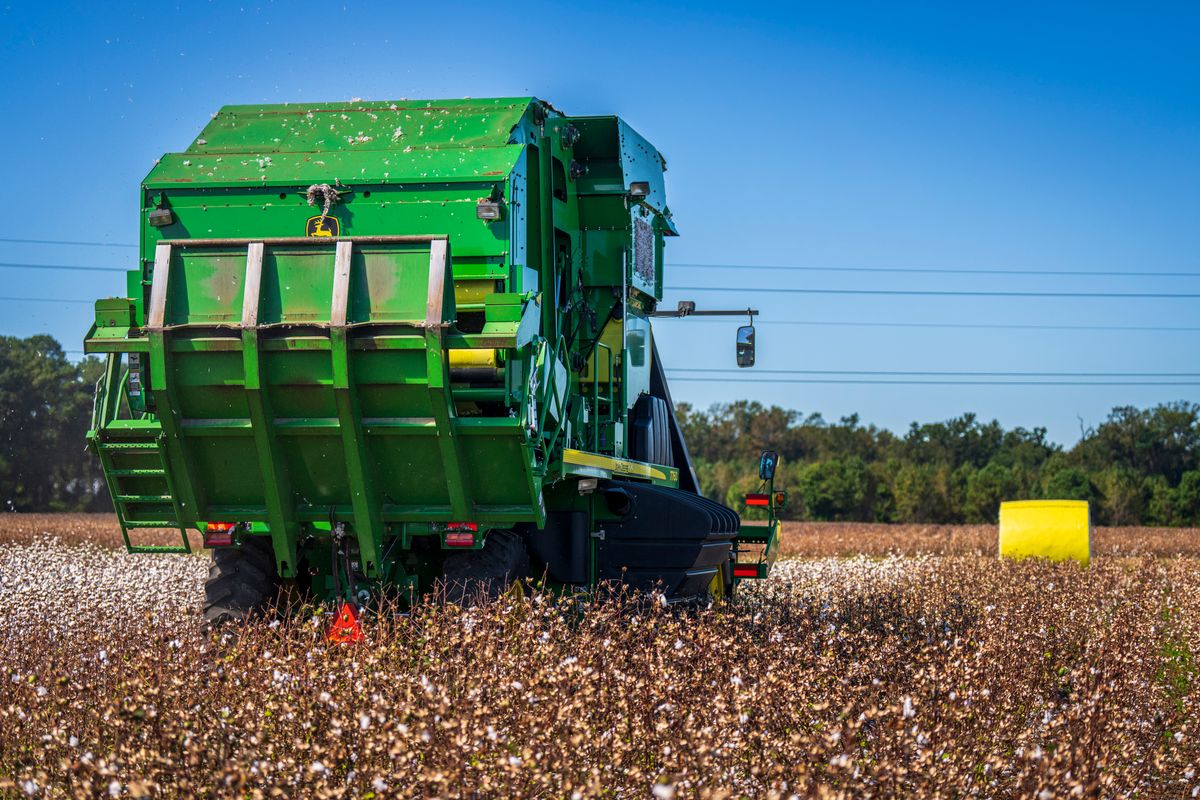
Image: Cotton harvest by machine — Source: Pexels, by Mark Stebnicki (Pexels License).
“Presumed guilty” at the US border
Picture your garment shipment from Vietnam held at a US port. Not for duty misdeclaration, not for missing paperwork — but because US Customs “presumes” a Xinjiang link somewhere in your supply chain. To release the goods, you must prove the opposite with clear and convincing evidence.
That is the mechanics of the Uyghur Forced Labor Prevention Act (UFLPA): signed in December 2021 and enforced from 21 June 2022, it establishes a rebuttable presumption — any goods mined, produced, or manufactured wholly or partly in Xinjiang, or made by entities on the UFLPA Entity List, are presumed to involve forced labour and are barred from import unless the importer rebuts the presumption.
For Vietnamese exporters to the US, the question is no longer “does this law apply to us” but “can our supply chain survive a UFLPA review.”
Why textiles, tomatoes, and polysilicon are high-risk
The US Forced Labor Enforcement Task Force designates high-priority sectors in its UFLPA enforcement strategy. Alongside newer additions (lithium, steel, copper, aluminium, PVC), three Vietnam-linked groups remain under close watch:
Textiles and cotton. Xinjiang cotton feeds deep into global garment supply chains. Vietnam’s exposure sits in raw materials: yarn and fabric imported from China, cut and sewn in Vietnam, then shipped to the US. Without traceability back to the cotton-growing stage, a garment consignment can be detained for verification. US Customs has indeed detained Vietnamese apparel shipments to examine Xinjiang nexus.
Tomatoes and tomato products. Xinjiang is a major tomato-paste producing region; tomato paste and ketchup from China-linked supply chains are monitored. Vietnam is not a tomato-processing hub for the US market, but agri-processors using imported inputs should take note.
Polysilicon. The key input for solar panels. Xinjiang accounts for a very large share of global polysilicon output, making solar panels and components among the most intensely inspected goods. Vietnam hosts major solar-panel production for the US market — the risk concentrates in silicon sourcing traceability.
The UFLPA Entity List keeps growing
A second enforcement tool is the UFLPA Entity List: listed companies’ goods face the forced-labour presumption. The US Department of Homeland Security updates the list regularly, with strong expansions — a mid-2026 round alone added dozens of entities, bringing the total near 200 across aluminium, apparel, copper, cotton, tomatoes, and downstream products.
Risk therefore extends beyond “goods from Xinjiang” in a geographic sense to any supply-chain link touching a listed entity — even when final assembly happens in Vietnam.
What Vietnamese businesses should prepare
1. Map the supply chain to the raw-material level. Go beyond tier-1 suppliers to tiers 2 and 3: where the yarn/fabric came from, where the cotton was grown, which plant produced the silicon. This is the core of what US Customs examines in a rebuttal package.
2. Verify evidence, don’t just collect certificates. Supplier attestations and certifications need independent verification (site checks, production-volume reconciliation, supply-chain audits). Paper-perfect files without real verification rarely survive deep review.
3. Diversify input sources. Reduce reliance on geographically high-risk inputs; prefer suppliers with transparent traceability systems willing to undergo checks.
4. Prepare a “UFLPA package” in advance. When goods are detained, response time matters. Keep ready per product/consignment: supply-chain maps, tier-by-tier purchase contracts and invoices, transport documents, production records, and independent verification evidence.
5. Write UFLPA into contracts. With input suppliers: duties to provide traceability information and liability for false data. With US buyers: allocation of responsibility and costs when goods are detained.
Conclusion
The UFLPA does not ban Vietnamese goods from the US — it bans goods that cannot prove themselves clean of Xinjiang forced-labour nexus. For textiles, tomatoes, and polysilicon — three groups where Vietnam ships large volumes to the US with supply chains tied to Chinese inputs — detention and review risks are real and rising alongside Entity List expansion. Exporters that build traceability down to raw-material roots not only avoid UFLPA risk but gain lasting competitive advantage in the US market.
Frequently asked questions
When did the UFLPA take effect?
Signed in December 2021, enforced from 21 June 2022. Enforcement has intensified since, with the Entity List and priority sectors continuously expanding.
Are goods made 100% in Vietnam affected?
In principle the presumption targets Xinjiang nexus or listed entities. But if inputs (yarn, fabric, silicon) are imported from China without traceable origin, consignments can still be detained for verification.
What does “rebuttable presumption” mean?
US Customs defaults to treating nexus goods as forced-labour products and denies entry; the importer must present clear and convincing evidence rebutting the presumption before goods are released.
How should a detained shipment be handled?
The importer must promptly submit the supply-chain traceability dossier and rebuttal evidence to US Customs. A pre-prepared “UFLPA package” shortens handling time significantly.
Do small businesses need to care about the UFLPA?
Yes, if exporting high-risk goods to the US or using Chinese-imported inputs. Company size does not exempt the burden of proof when goods are inspected.
This article has been quality-reviewed by the FLAW AI Legal Council
Related articles
- EVFTA and Vietnamese Footwear: Understanding the 10% Tolerance Trap
- UKVFTA and EU Material Cumulation: Correcting a Costly Misunderstanding
- EVFTA and Vietnamese Textiles: A 3-Step Formula for 0% Duty
- Vietnamese Solar Panels and US Duties: The AD/CVD and Circumvention Spiral
- The CPTPP Investment Chapter: Protecting Canadian, Australian and Mexican Investors in Vietnam