
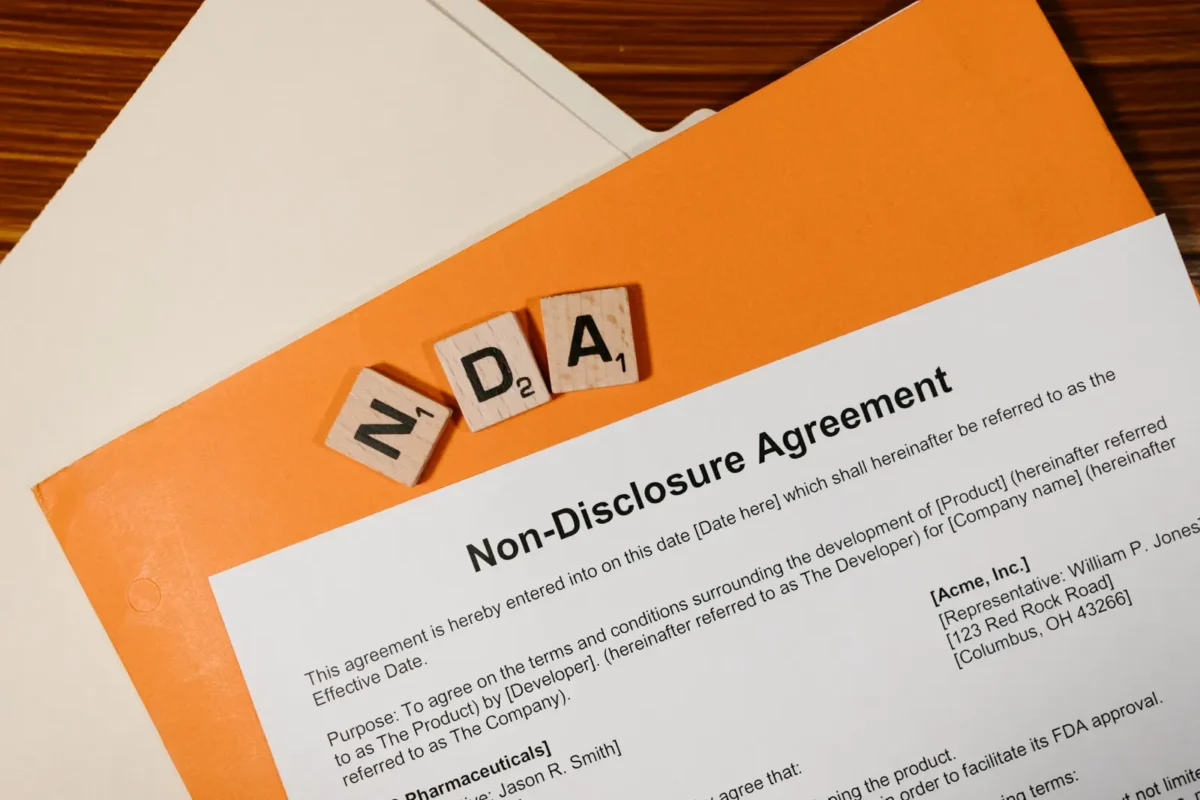
The company’s R&D manager resigns; two weeks later, he appears at a direct competitor. Soon after, the competitor launches a product with a formula nearly identical to the core technology the company spent years developing. What can the company do now — and more importantly, what should it have done beforehand to avoid this vulnerable position? This article provides a two-stage action checklist for businesses.
Part 1 — Prevention: act before key employees leave
The effectiveness of any later remedy depends almost entirely on whether the company had a written confidentiality agreement in place. Without one, legal tools still exist but proving the case becomes far harder.
1. Sign a written trade secret protection agreement
Clause 2, Article 21 of the Labor Code 2019 provides: “Where an employee works in direct connection with trade secrets or technological secrets as prescribed by law, the employer may agree in writing with the employee on the content, duration of trade secret and technological secret protection, benefits, and compensation in case of violation.”
Under Clause 1, Article 4 of Circular 10/2020/TT-BLDTBXH, the employer may agree on trade secret and technological secret protection content in the labor contract or in another written document. A good agreement should clearly specify:
- Trade secret catalogue: the specific types of protected information (formulas, processes, customer lists, pricing strategies);
- Scope of use: the limits within which the employee may access and use the information;
- Post-employment confidentiality period: as agreed by the parties;
- Protection measures: the technical and organizational measures the company applies;
- Compensating benefits for the employee during the confidentiality obligation period;
- Compensation for breach of the agreement.
Note: the precondition is that the employee works in direct connection with trade or technological secrets — not every position qualifies, and companies should not impose such agreements indiscriminately on all staff.
2. Non-compete agreements: use them correctly
Vietnamese law does not define and has no dedicated provisions directly governing non-compete agreements. This means a non-compete is neither automatically void nor automatically enforceable — its validity and enforceability depend on the court’s assessment in each specific case.
The closest legal basis is the principle of freedom of agreement (Article 117 of the Civil Code 2015: a civil transaction is valid where it does not violate statutory prohibitions or social ethics) combined with Clause 2, Article 21 of the Labor Code 2019. Case law is divided:
- Precedent 69/2023 recognized the legality of non-compete agreements on freedom-of-agreement grounds;
- Draft Precedent 33/2026 (from Company T. v. Mr. D.) declared a work-restricting agreement legally void where it contravened Article 35 of the Constitution (the right to choose an occupation and employment) and the Labor Code’s freedom of job choice — particularly where the new employer was in a different industry, not a competitor, and the former employer could not prove the employee had disclosed secrets. Note: this is still a draft, not an official precedent.
What companies must remember: the law sets no maximum duration for non-compete agreements and provides no standard template. Any widely circulated “standard” figure (e.g. “maximum 2 years”) is not a statutory rule. Courts will examine reasonableness of scope, duration, and compensating benefits for the employee.
3. Technical measures and access control
Alongside paper agreements, companies should apply necessary confidentiality measures: role-based data access, encryption, access logs, and handover and device-recovery procedures when employees leave. This is also one of the three conditions for information to qualify as a trade secret (see Part 2).
Part 2 — Response: checklist upon discovering a breach
Step 1: Determine whether the taken information qualifies as a protected trade secret
Under Article 84 of the consolidated Intellectual Property Law (Consolidated Document 67/VBHN-VPQH 2026), information is protected as a trade secret when it simultaneously meets three conditions:
- It is not common knowledge and not easily obtainable;
- Its use in business gives the holder an advantage over those who do not hold it;
- It is kept confidential by the owner through necessary measures.
Meanwhile, Article 85 of Consolidated Document 67 excludes certain subject matter from trade secret protection: personal secrets, state management secrets, national defense and security secrets, and other confidential information unrelated to business. (Exact article numbers in Consolidated Document 67 should be verified against the original text.)
Step 2: Review the signed confidentiality and non-compete agreements
Re-examine all agreements signed with the employee: the scope of protected information, the post-employment obligation period, and breach compensation levels. These form the direct basis for compensation claims under the agreement.
Step 3: Collect evidence of the infringing acts
Article 127 of Consolidated Document 67 lists acts infringing trade secret rights, including: accessing or collecting by defeating confidentiality measures; disclosing or using without the owner’s permission; breaching a confidentiality contract or deceiving, instigating, bribing, coercing, enticing, or abusing the trust of a person under a confidentiality duty; using or disclosing a trade secret while knowing or having a duty to know it was obtained through infringing acts.
The burden of proof lies with the company. The company must prove four elements: (i) the information is a protected trade secret; (ii) the employee accessed it during employment; (iii) unauthorized use or disclosure; and (iv) actual damage. The law does not allow the company to claim compensation as a matter of course without proving damage and the violation.
Step 4: Send a formal cease-and-desist demand
Send an official written demand to the violating individual and, with grounds, to the competitor, requiring immediate cessation of the use and disclosure of the trade secret, citing the signed agreement and legal provisions. This step is both a good-faith gesture and evidence for subsequent steps.
Step 5: Sue for damages
Based on the signed confidentiality agreement and legal provisions, sue before the competent People’s Court (labor or civil disputes under the Civil Procedure Code 2015) for damages.
Step 6: Report unfair competition
Article 45 of the Competition Law 2018 prohibits infringing business confidential information (unauthorized access, collection, disclosure, or use of trade secrets). The company may report to the competent competition authority for handling of the competitor’s unfair competition conduct.
Step 7: Discipline the employee if still employed
If the employee is still working for the company when disclosing trade or technological secrets, the company may impose the disciplinary form of dismissal under Clause 2, Article 125 of the Labor Code 2019 (verify the exact basis against the original text).
What the law does not provide — common misunderstandings
- The law does not automatically prohibit a former employee from working for a competitor — it only prohibits trade secret infringement and breaches of a lawfully signed confidentiality agreement;
- The law does not require registration of trade secrets for protection (unlike patents or trademarks);
- The law has no concept or dedicated provisions on “non-compete agreements” — do not cite non-existent articles;
- Administrative IP fines (Decree 99/2013/ND-CP as amended by Decree 186/2026/ND-CP): specific fine levels for trade secret infringement must be verified against the original text; unverified figures should not be applied.
Applicable legal framework (in force at 14 October 2026)
- Labor Code 45/2019/QH14 (Consolidated Document 18/VBHN-VPQH 2026): Clause 2, Article 21; Clause 2, Article 125 — in force; the cited articles are unaffected by amendments.
- Intellectual Property Law — Consolidated Document 67/VBHN-VPQH 2026 (consolidated up to Law 131/2025/QH15, effective 1 April 2026): Articles 84, 85, 127 — in force.
- Competition Law 23/2018/QH14 (effective 1 July 2019): Article 45 — in force.
- Circular 10/2020/TT-BLDTBXH (effective 1 January 2021): Clause 1, Article 4 — in force.
- Civil Code 91/2015/QH13: Article 117 — in force.
- Precedent 69/2023 (published); Draft Precedent 33/2026 — not yet an official precedent.
Frequently asked questions
Can the company still sue without a signed confidentiality agreement?
It can, but with much greater difficulty. The company must prove the information meets the three conditions of Article 84 of Consolidated Document 67 and prove infringing acts under Article 127, without an agreement as the direct basis for compensation claims.
Will a court certainly uphold a non-compete agreement?
Not certainly. Vietnamese law has no dedicated non-compete provisions; Precedent 69/2023 upheld one on freedom-of-agreement grounds, while Draft Precedent 33/2026 (not yet official) voided one restricting the constitutional right to work. Validity depends on each court’s case-by-case assessment.
What if the employee independently develops similar technology after leaving?
The trade secret owner has no right to prohibit others from disclosing or using a trade secret created independently or lawfully obtained without knowledge or a duty to know — a key exception companies must consider when evaluating a case.
Related articles
Contact FLAT Law Firm for advice on building a trade secret protection system and handling disputes.
Note: This article is for general reference only based on the law in force at the time of writing (14 October 2026) and does not constitute legal advice for any specific case. Legal provisions may change; specific cases require a lawyer’s opinion.
Transparency note: This article was drafted by FLAT Law Firm’s AI content production system and is undergoing internal review (AI Legal Council QA and owner approval before publication). It has not been reviewed by a human lawyer.