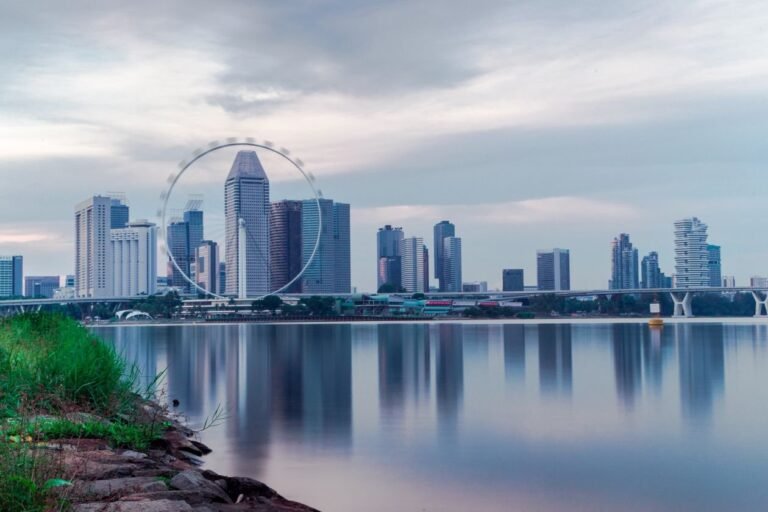
Singapore is the only Southeast Asian nation importing nearly all its energy while recycling most of its water — yet it runs among the world’s most reliable utility infrastructure. The paradox is resolved by technology and price: Singapore users pay high tariffs for absolute reliability. Against Vietnam, this is the pricing of certainty.
Singapore: PUB, NEWater and an unsubsidised power market
The Public Utilities Board (PUB) runs NEWater — reclaimed wastewater treated to potable standards — meeting much of industrial demand and cutting reliance on Malaysian water imports. On power, the Energy Market Authority (EMA) runs a competitive wholesale market with no subsidies: Singapore’s industrial tariffs rank among Asia’s highest and track imported gas prices.
Reliability is absolute: Singapore’s power and water grids are virtually interruption-free, underpinning data centres and wafer fabs. JTC estates are master-planned with power, water and telecoms from day one — no factory drills its own well or runs temporary power.
Vietnam: abundant resources, cheap tariffs, rising reliability
Under the Electricity Law 61/2024/QH15 (effective 1 February 2025), Vietnamese retail tariffs follow a regulated market mechanism, with industrial power among the region’s cheapest — often one-third to one-quarter of Singapore’s. Industrial water is abundant from river systems at a fraction of Singapore’s cost.
The gap lies in reliability and management: Vietnam still sees localised dry-season power cuts, and water quality varies across parks. But with such a wide price gap, factories can invest in backup systems (water tanks, generators, UPS) and still land far below Singapore’s total cost.
Pay for certainty or engineer it yourself
Choose Singapore when processes allow zero utility risk (data centres, fabs) and customers pay a premium for reliability. Choose Vietnam when reliability can be engineered through backup systems at far lower cost. For most ordinary factories, the Vietnam-plus-backup option cuts total utility costs by 60-80%.
This article has been quality-reviewed by the FLAW AI Legal Council.
Frequently Asked Questions
How wide is the Singapore-Vietnam industrial power gap?
Singapore's industrial tariffs rank among Asia's highest, unsubsidised and tracking imported gas prices — often 3-4 times Vietnam's. Vietnam's industrial power is among the region's cheapest under EVN's tables. The gap is the main driver of the produce-in-Vietnam model.
What is special about Singapore's NEWater system?
NEWater is reclaimed wastewater treated through membrane technology to high standards, run by PUB, meeting much of Singapore's industrial water demand. The model cuts reliance on water imports — a water-security lesson Vietnamese parks in water-scarce regions can study.
Is Singapore's utility reliability worth the price?
For data centres and wafer fabs — where one incident costs millions — yes. For ordinary manufacturing, the price gap makes the Vietnam-plus-backup option far more economical. Decide on the cost of one incident, not on feelings about reliability.