
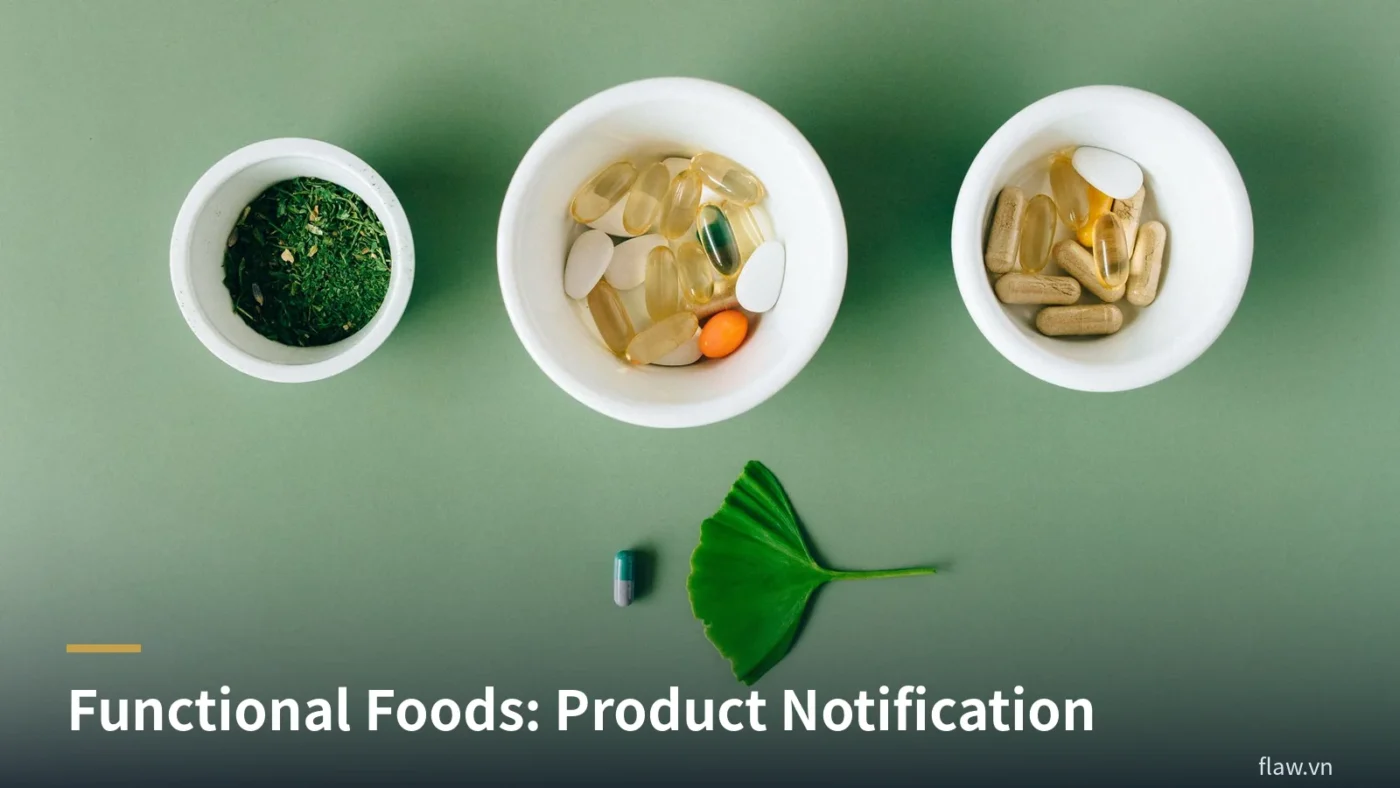
Short answer: In Vietnam, what consumers call “functional foods” are regulated as health supplements (thực phẩm bảo vệ sức khỏe) — and these products must complete product declaration registration; self-declaration is not permitted. The governing law is Decree 15/2018/ND-CP, which remains in force today.
1. What counts as a “functional food” in law?
Vietnamese law does not use “functional food” as a standalone product category. The products consumers call functional foods correspond to health supplements under Circular 43/2014/TT-BYT. Classifying your product correctly determines which declaration mechanism applies — get this wrong and everything downstream is wrong.
2. Two declaration mechanisms: self-declaration vs. registration
Decree 15/2018/ND-CP provides two tracks:
- Self-declaration (Article 5): only for pre-packaged processed foods, food additives, food processing aids, and food packaging materials/tools — excluding products subject to registration.
- Product declaration registration (Articles 7 and 8): applies to health supplements and certain other special groups.
Health supplements fall under mandatory product declaration registration — a company may not simply self-declare and go to market. This is the most common source of violations.
Competent authority: for imported products, the National Food Safety Authority (Ministry of Health) issues the Receipt of Product Declaration Registration (Article 7(1), Article 8 of Decree 15/2018).
3. Registration dossier: watch the testing report
Under Articles 7 and 8 of Decree 15/2018/ND-CP, the dossier includes the prescribed documents, notably the testing result report. Key points:
- The testing report must be no older than 12 months from the dossier submission date;
- It must be issued by a designated testing laboratory or a laboratory accredited to ISO 17025.
Many dossiers stall on this item alone — an expired report or one from an unqualified lab. Lock this down before filing.
Also note: Decree 15/2018 sets no validity period for the Receipt of Product Declaration Registration.
4. Manufacturing conditions: GMP and contaminant limits
Selling health supplements is not only about product paperwork — the manufacturing site must also comply:
- GMP: health supplement manufacturers must hold a food safety eligibility certificate meeting Good Manufacturing Practice (GMP) requirements (Article 29 of Decree 15/2018/ND-CP).
- QCVN 20-1:2024/BYT: products must meet the national technical regulation on contaminant limits issued with Circular 12/2024/TT-BYT, effective 1 August 2025.
Importers should require the foreign manufacturer to provide GMP evidence and testing results meeting the QCVN at the contract negotiation stage.
5. Current legal status: Decree 15/2018 remains the applicable basis
A confusing development in 2026: Decree 46/2026/ND-CP (enacted to replace Decree 15/2018) is currently suspended — along with Resolution 66.13/2026/NQ-CP — under Resolution 15/2026/NQ-CP (6 April 2026), until the amended Food Safety Law and its guiding decree take effect.
Practical consequences:
- Decree 15/2018/ND-CP remains the applicable basis — file declarations under this decree;
- The amended Food Safety Law is only a draft (not yet passed by the National Assembly) with no effective date — do not anticipate its content;
- Circular 48/2025/TT-BYT on decentralizing food safety administrative procedures takes effect 30 December 2025 — not applicable yet.
6. Risks of trading without declaration
Trading health supplements without product declaration registration (or with an improper declaration) may attract administrative sanctions under the sectoral sanctioning decree on food safety — review the sanctioning text in force to determine the fine for each act — plus remedial measures (product recall, destruction).
FAQ
Can functional foods be self-declared? No. Health supplements are subject to mandatory product declaration registration under Articles 7 and 8 of Decree 15/2018/ND-CP.
Where do importers file? The National Food Safety Authority (Ministry of Health) issues the Receipt of Product Declaration Registration for imported products (Article 7(1), Article 8 of Decree 15/2018).
Does the receipt have an expiry date? Decree 15/2018 does not set a validity period for the receipt.
What manufacturing conditions apply to health supplements? Good Manufacturing Practice (GMP) under Article 29 of Decree 15/2018, and products must meet QCVN 20-1:2024/BYT (Circular 12/2024/TT-BYT, effective 1 August 2025).
Legal sources
- Law on Food Safety 55/2010/QH12 (effective 1 July 2011; amended by Law 28/2018/QH14 and the 2025 Inspection Law) — in force.
- Decree 15/2018/ND-CP (effective 2 February 2018) — in force, the current applicable basis.
- Resolution 15/2026/NQ-CP (6 April 2026) — suspending Decree 46/2026/ND-CP and Resolution 66.13/2026/NQ-CP.
- Circular 12/2024/TT-BYT — QCVN 20-1:2024/BYT (effective 1 August 2025).
See also: FLAT Law Firm’s [Corporate Legal Services](/en/corporate-legal-services-en/) updates on sectoral business conditions.
Need help with health supplement declaration registration? [Contact FLAT Law Firm](/en/contact/) for a dossier review and an implementation roadmap for your case.
Disclaimer: This article is for general information only and does not constitute legal advice for any specific case. Regulations may change; always verify against the original legal text in force at the time of application.
Transparency note: This article was reviewed for quality and legal accuracy by FLAT Law Firm’s AI Legal Council; it has not been reviewed or approved by a human lawyer of FLAT Law Firm.