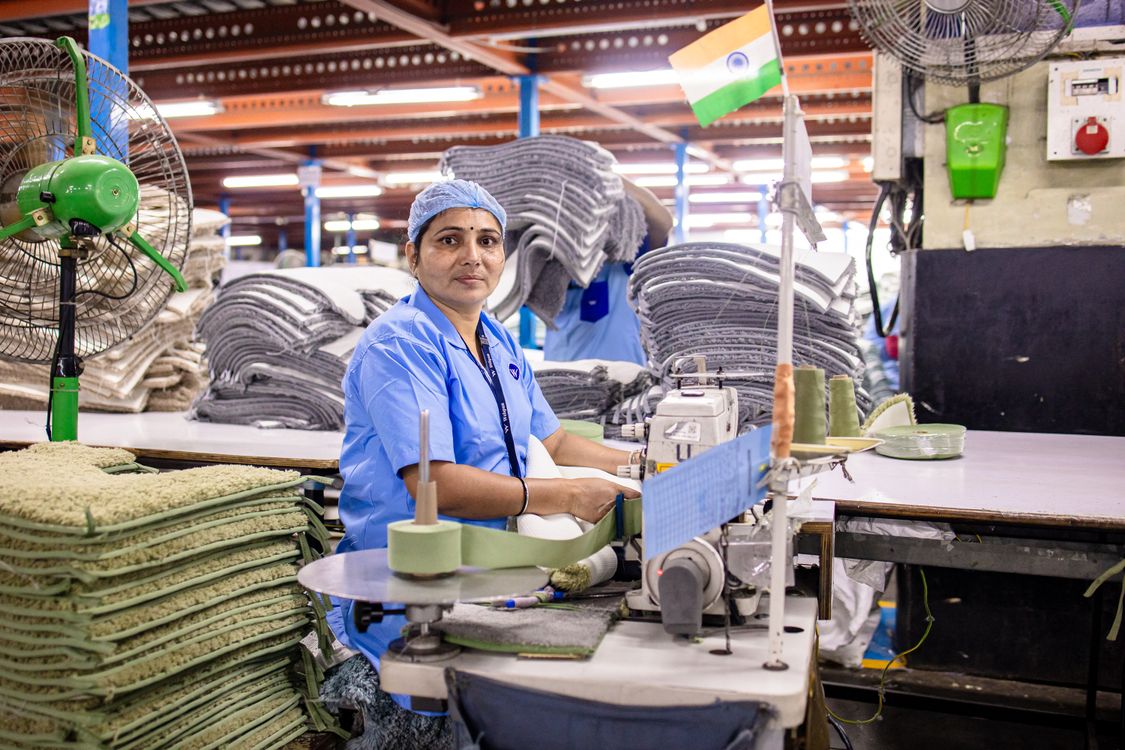
Illustration: a garment worker at a sewing machine, illustrating the textile export industry — source: Pexels (free to use).
A real-world scenario: A garment maker in Nam Dinh receives an order for 50,000 men’s shirts bound for France. The buyer insists the goods must qualify for the EVFTA 0% preferential duty — otherwise the price cannot compete with Bangladesh. The chief accountant is stuck: the company imports fabric from China for sewing — does that meet origin requirements? Where is the EUR.1 applied for, and what is the latest procedure? The answer is the 3-step formula below — applicable to any textile product exported to the EU.
1. Context: EVFTA opens the door — conditionally
The EVFTA has applied since 1 August 2020, opening major opportunities for Vietnamese textiles: the EU committed to eliminating tariffs on 77.3% of Vietnam’s textile export turnover within 5 years of the agreement’s entry into force, with the remaining 22.7% eliminated after 7 years (Ministry of Industry and Trade figures). But 0% duty does not apply automatically to every “made in Vietnam” shipment — goods must prove compliance with the EVFTA rules of origin (Protocol 1). For textiles, these rules are famously strict, and that is what steps 1 and 2 of the formula address.
2. Step 1: classify the HS code and look up the product-specific rule
Every textile product carries an HS code (e.g., knitted men’s shirts fall in Chapter 61, woven shirts in Chapter 62). The product-specific origin rule for each code sits in Annex II of EVFTA Protocol 1 — note this annex has been updated to the HS 2022 nomenclature (Decision 2/2024 of the EVFTA Trade Committee, effective 1/1/2024). Looking rules up by the old HS code (HS 2017) risks applying the wrong rule.
The correct method: determine the product’s HS 2022 code, find the corresponding rule in Annex II (updated version), and record exactly what it requires for your code. That is the “exam question” — step 2 is the “worked solution.”
3. Step 2: clear the “from yarn onwards” rule — double transformation
For most apparel, the EVFTA origin rule requires “from yarn onwards” — production must start from the yarn stage in Vietnam or the EU. Concretely, both key stages — weaving/knitting fabric from yarn and cutting and sewing the finished garment — must take place in Vietnam (or the EU, or a cumulation partner).
Illustration:
– Fails: importing finished fabric from China and only cutting/sewing in Vietnam → only one stage performed domestically → does not meet “from yarn onwards.”
– Passes: importing yarn, weaving it into fabric in Vietnam, then cutting and sewing in Vietnam → both stages performed → meets the rule.
This is where many businesses’ hopes break: a pure CMT (cut-make-trim) model using imported non-EVFTA fabric does not qualify for preferences. Practical fixes: switch to importing yarn (or fabric from the EU/South Korea — see the cumulation mechanism), invest in or partner for domestic weaving/dyeing, or restructure the material supply chain.
4. Step 3: prepare origin documents under the current rules
Meeting the origin rule is only half the journey — the other half is proving it with valid documents at EU customs. Businesses have two options:
Option 1 — EUR.1 movement certificate issued by bodies authorized by the Ministry of Industry and Trade, based on the exporter’s origin dossier.
Option 2 — self-certification via an origin declaration on the commercial invoice or transport document: consignments up to EUR 6,000 — any exporter may self-certify; above EUR 6,000 — only eligible/registered exporters.
Important update: EVFTA origin certification procedures now follow Circular 14/2026/TT-BCT (effective 10 May 2026), replacing Circular 11/2020/TT-BCT. Businesses still running the old TT 11/2020 process must update immediately — wrong forms or wrong issuing authority will get the certificate rejected at EU customs.
Finally, keep origin records for at least 3 years — EU customs may verify after clearance, and exporters unable to produce supporting documents face retroactive duty collection plus penalties.
The information in this article is general reference on the law as of the date of writing (18 October 2026) and does not replace legal advice for any specific case.
Frequently asked questions
1. Does importing Chinese fabric for sewing in Vietnam qualify for 0% EVFTA duty?
Usually not, because it fails the “from yarn onwards” rule (missing the domestic yarn-to-fabric stage). To qualify, weave the fabric in Vietnam/the EU from yarn, or use fabric of cumulated origin.
2. Where do I apply for a EUR.1?
At bodies authorized by the Ministry of Industry and Trade to issue C/O (regional import-export management offices and authorized organizations). Current procedures follow Circular 14/2026/TT-BCT.
3. What are the conditions for self-certification of origin?
Consignments up to EUR 6,000: any exporter may self-certify on the invoice or commercial document. Above EUR 6,000: only exporters meeting the eligibility/registration conditions.
4. How does the HS 2022 update affect origin rule lookup?
Annex II of Protocol 1 has been updated to HS 2022 (effective 1/1/2024). Businesses must look rules up by HS 2022 codes; using old codes risks applying the wrong rule and losing preferences.
5. Where do I check the EVFTA duty rate for a textile product?
In the special preferential import tariff issued with Decree 116/2022/ND-CP (the EVFTA tariff schedule for 2022–2027, the currently effective text replacing Decree 111/2020/ND-CP). Note this is Vietnam’s import schedule — the EU’s preferential rates are checked in the EU tariff (TARIC).
This article has been quality-reviewed by the FLAW AI Legal Council
Related articles
- Top 5 Provinces Attracting the Most Chinese Capital
- Consumer Electronics Components: China Plus 1 Opportunities for Suppliers
- Lithium Battery Cathode and Anode Materials: A Niche for Korean and Chinese Investors
- Chinese investors opening vocational training facilities in Vietnam: conditions and technology transfer notes
- Disputes over Land Rental and Land Use Fees for FDI Projects