
Under EVFTA, Vietnamese exporters are not obliged to obtain a C/O EUR.1 for every consignment — they may make out a “statement on origin” directly on the commercial invoice or another commercial document. Convenient as this is, self-certification is also where most errors occur, particularly in the “origin criterion” field for footwear (Chapter 64). This guide walks through each required field, focusing on how to determine and state the origin criterion for shoes.
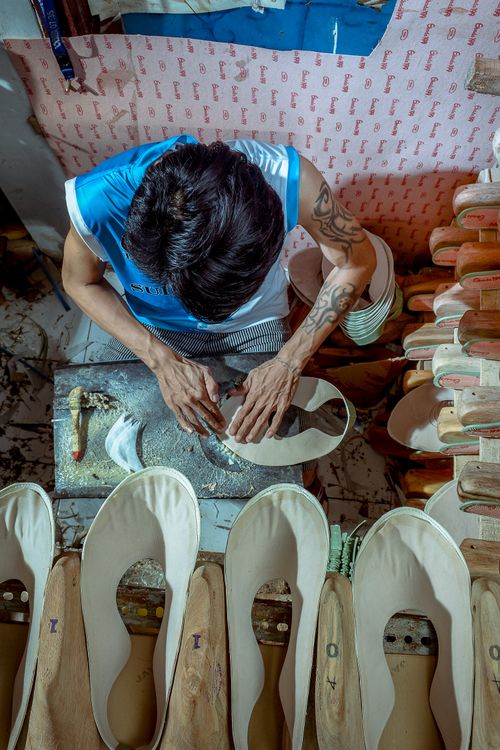
Image: Noel Snpr / Pexels — free stock photo.
1. What a statement on origin is, and when to use it
A statement on origin is made out by the exporter itself, following the model in Annex VI to Circular 14/2026/TT-BCT (effective 10 May 2026, replacing Circular 11/2020/TT-BCT), on the commercial invoice or another commercial document describing the goods in sufficient detail for identification. It is one of two forms of origin certification under EVFTA, alongside the C/O EUR.1 issued by the competent authority.
The key legal point: a self-made statement carries the same weight as a C/O for claiming tariff preference — and the exporter bears full responsibility for its accuracy. When EU customs has doubts, it verifies the exporter that made the statement, not a C/O-issuing body.
2. Anatomy of a compliant statement
Under the Annex VI model, a valid statement contains these mandatory elements:
- The certification wording in the prescribed form (in English), in which the exporter declares the goods qualify for EVFTA preferential origin;
- The exporter’s identification number (registration number under the applicable scheme — use exactly the number issued);
- The origin criterion applied to each product — the most error-prone field, detailed in section 3;
- A goods description sufficient to identify the consignment (product name, HS code, quantity);
- The signature of the authorised person and the date of issue.
Missing any element can render the statement invalid — and cost the consignment its preference.
3. Stating the criterion for footwear: “P” or “W + HS code”?
The origin criterion shows the basis on which the goods qualify. For footwear in practice there are only two possibilities:
- “P” — wholly obtained goods: applies where all processes and materials originate in Vietnam/the EU under Article 6 of Circular 14/2026/TT-BCT. For industrial footwear this is rare — virtually no sports shoe is made without imported adhesives, threads or accessories. Stating “P” while using non-originating inputs is a serious error.
- “W” + HS code (4 or 6 digits) — goods meeting the product-specific rule: the normal case for footwear. Example: sports shoes of HS 6404 state “W 6404”, meaning the product satisfies the product-specific rule for heading 6404 in Annex II.
The selection rule: determine the finished product’s HS code first, look up the product-specific rule in Annex II, verify the product complies — if yes, state “W” with that HS code; state “P” only where the goods are genuinely wholly obtained.
4. The product-specific rule for footwear (Chapter 64)
Annex II to Circular 14/2026/TT-BCT sets a specific rule per footwear heading. The standard formula for headings 6401–6405 is: manufacture from materials of any heading, except from assemblies of uppers affixed to inner soles or to other sole components of heading 6406.
What this means in practice:
- The factory may use third-country leather, textiles, rubber and accessories (any HS heading) — provided it does not import ready-made “uppers affixed to soles” (heading 6406) for light finishing and re-export. Simple assembly from 6406 semi-finished goods does not confer origin.
- The decisive processing must take place in Vietnam and go beyond minimal operations (cutting, stitching, bonding uppers to soles must be genuine manufacturing).
- For each sub-heading (sports footwear 6404, leather shoes 6403, etc.), consult the exact rule line for that sub-heading in Annex II — never infer from another heading.
5. Four common misstatements on footwear origin statements
Error 1 — Stating “P” for shoes with imported inputs. As analysed, industrial footwear is almost never wholly obtained. A “P” that misrepresents the facts is grounds for immediate preference denial on verification.
Error 2 — Stating “W” with the wrong HS code. Example: the finished product is sports footwear 6404 but the statement reads “W 6403” after confusion with another product line. The criterion must attach to the finished product’s declared HS code.
Error 3 — One statement covering multiple criteria without line separation. An invoice containing both “W 6404” shoes and “P” shoe accessories must show the criterion per line item, not one blended criterion for the whole invoice.
Error 4 — Missing exporter number or signature. A statement without the identification number or signature is incomplete — an administrative error with consequences equivalent to a wrong criterion: loss of preference.
6. Who may make out the statement, and where
The exporter of the goods makes out the statement. Under the EVFTA mechanism, for consignments above the prescribed value threshold the exporter must be registered under the exporter scheme (REX/self-certification) and use the issued number; consignments below the threshold may be certified by any exporter. The statement is placed on the commercial invoice; where the invoice is unsuitable, it may go on another commercial document (packing list, delivery note) provided the goods description allows identification and the consignment reference is clear.
Frequently asked questions
1. Which model applies to the statement on origin?
The model in Annex VI to Circular 14/2026/TT-BCT, made out in English on the commercial invoice or another commercial document.
2. What criterion do Vietnamese-made sports shoes from imported leather carry?
“W” plus the finished product’s HS code (e.g., “W 6404” for heading 6404 sports footwear), provided the product meets the product-specific rule in Annex II (the “manufacture from materials of any heading, except assemblies of uppers affixed to inner soles or to other sole components of heading 6406” formula).
3. When may “P” be stated for footwear?
Only where the goods are wholly obtained under Article 6 of Circular 14/2026/TT-BCT — extremely rare for industrial footwear. If any non-originating input is used, state “W + HS code”.
4. How to handle one invoice with several products under different criteria?
Show the origin criterion separately for each line item; do not blend one criterion across the whole invoice.
5. Is a statement without signature acceptable?
No. The statement must contain all mandatory elements including the exporter number, origin criterion, goods description and signature. A missing element can invalidate the document.
6. What happens if the criterion is misstated?
The consignment may be denied EVFTA preference when EU customs examines or verifies it. Correct promptly following the competent authority’s guidance and fix the process for future shipments; duties may be recovered for cleared consignments.
Conclusion
For footwear shipped to the EU, the statement on origin is the “ticket” to tariff preference — and the origin-criterion field is where the ticket tears most easily. The golden rule: identify the finished product’s HS code correctly, look up the exact product-specific rule in Annex II, state “W + HS code” accurately (or “P” in the rare wholly-obtained case), and ensure the number and signature are present. An internal cross-check before issuing each statement eliminates most of the risk.
—
This article has been quality-reviewed by the FLAW AI Legal Council
Related articles
- Statements on Origin for Wooden Furniture Exports to the EU: Stating the Origin Criterion Correctly
- Consular Legalization of Parent-Company Documents: New Rules from 9/2026 (Apostille)
- Proving the Parent Company's Financial Capacity in the IRC Dossier: The File Dissected
- Minimum Capital for a 100% Foreign-Owned Company: Three Capital Concepts
- Holding Companies in Vietnam: Legal Reality and 3 Structural Decisions