
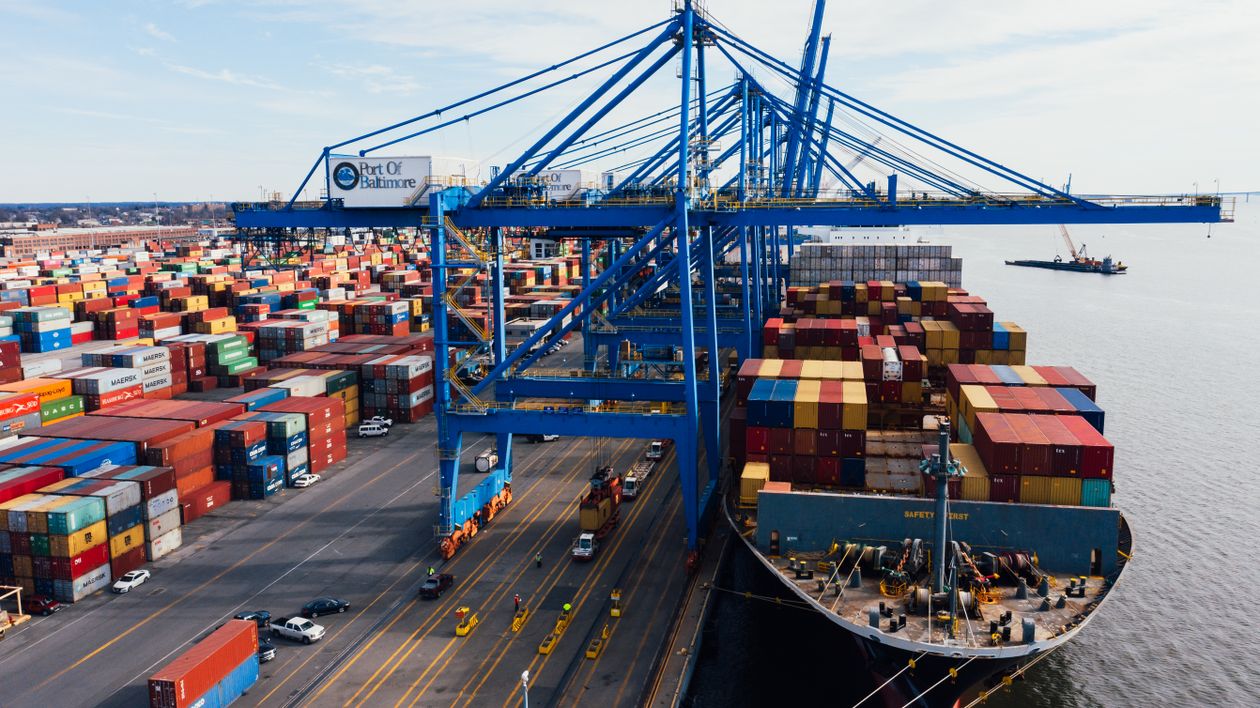
Illustration: a cargo ship unloading containers at port, illustrating goods exports to the EU — source: Pexels (free to use).
A real-world scenario: A steel company in Hai Phong exports 800 tonnes of steel coil to Germany each year. In November 2026, its importer emails: “From 1/1/2026 CBAM applies in full; we need to designate an authorised declarant. Can you register as a declarant in the EU, or must we hire a customs representative?” The Vietnamese director is puzzled: what exactly is CBAM, what role does a non-EU business play in it, and what happens to 2026 shipments without preparation?
1. What is CBAM and what is the timeline?
CBAM — the EU’s Carbon Border Adjustment Mechanism, Regulation (EU) 2023/956 — requires importers of six product groups (cement, iron and steel, aluminium, fertilisers, electricity, hydrogen) into the EU to purchase CBAM certificates corresponding to the carbon embedded emissions in the goods. The goal: prevent carbon leakage and protect EU producers already paying a carbon price under the ETS.
The timeline has two phases. Transitional phase (1 October 2023 – 31 December 2025): importers only had to report emissions, not buy certificates. Full application from 1 January 2026: importers must be registered “authorised declarants,” file annual CBAM declarations, and purchase matching certificates — the first declaration, for 2026, is filed in 2027. The 2025 amendment (Regulation (EU) 2025/2083, in force 20 October 2025) added a 50-tonne-per-year exemption threshold: importers bringing in less than 50 tonnes of CBAM goods annually fall outside the scope.
2. Can a Vietnamese business act as “authorised declarant”? The answer is no
This is the key point many Vietnamese businesses misunderstand. CBAM rules require the authorised declarant to be established in the EU. A company based solely in Vietnam, even as the direct manufacturer, cannot register as a declarant.
So who acts as declarant for your shipment? Two options:
Option 1 — the EU importer acts as declarant itself. This is the most common model: your EU buyer registers as the authorised declarant, files the declaration, and buys the CBAM certificates. The certificate cost is in principle borne by the importer, but in practice they will negotiate to share it or pass part of it into the purchase price.
Option 2 — appoint an indirect customs representative in the EU. Under the 2025 amendment, where the importer is not established in the EU, its indirect customs representative in the EU assumes the declarant role. This typically arises when the Vietnamese business sells on DDP terms (delivered duty paid) or through an importer with no EU presence.
Conclusion: a Vietnamese business neither needs to — nor can — hire a customs representative to “do CBAM” for itself. That belongs to the import side. But do not relax yet — your real role is in the next section, and it decides whether your shipments stay competitive.
3. The Vietnamese business’s real job: supplying emissions data
CBAM charges are based on the actual embedded emissions of each consignment. The importer can only calculate correctly if the Vietnamese manufacturer supplies emissions data following the EU methodology (covering raw materials, production energy, metallurgical processes, and so on).
If the Vietnamese business cannot supply data, the importer must use the EU-published default values — which are deliberately set higher than the real figures of an efficient producer. The chain reaction: more CBAM certificates to buy → higher import cost → the EU partner negotiates the purchase price down, or simply switches to a supplier in another country that already has complete emissions data.
In other words: in the CBAM era, emissions data is part of competitiveness, on par with price and quality. Steel, aluminium, cement, and fertiliser exporters to the EU should now: (a) measure and document emissions per the EU methodology, (b) seek independent third-party verification where possible, and (c) write emissions-data supply clauses into sales contracts.
4. A checklist for Vietnamese businesses before each EU export contract
- Confirm whether the goods fall under CBAM: check the product’s HS code against the six groups (iron and steel is the largest, covering many HS codes).
- Clarify with your partner who acts as declarant: the importer registering itself or hiring an indirect customs representative — put it in the contract to avoid blame-shifting when penalties arise.
- Agree on emissions data: commit to supplying figures per the EU methodology, delivery deadlines, and who bears measurement/verification costs.
- Negotiate the price clause: who bears the CBAM certificate cost and how it is shared — do not wait until the partner deducts money to start arguing.
- Watch the 50-tonne threshold: if the partner’s total imports fall below it, shipments may be out of scope — but do not build long-term plans on this.
The information in this article is general reference on the law as of the date of writing (18 October 2026) and does not replace legal advice for any specific case.
Frequently asked questions
1. Must a Vietnamese business register anything in the EU to export CBAM goods?
No. The authorised declarant registration duty belongs to the EU import side. A Vietnamese business cannot and need not register. Your job is supplying emissions data to your partner.
2. How is the 50-tonne-per-year threshold calculated?
On the total mass of CBAM-scope goods one importer brings into the EU in a calendar year. Below the threshold, that importer is out of CBAM scope — but the threshold applies per importer, not per exporter.
3. Since when is Vietnamese steel exported to the EU subject to CBAM?
Transitional phase (reporting only) from 1 October 2023; full application from 1 January 2026 — from which point importers must buy CBAM certificates matching embedded emissions.
4. What if emissions data cannot be supplied?
The importer must use EU default values, usually higher than reality, inflating certificate costs. The commercial consequence: price pressure or lost orders to competitors that already have data.
5. Who is the indirect customs representative, and where is one hired?
An EU-established customs services business authorized by an importer with no EU presence to handle customs formalities and — under the 2025 amendment — assume the CBAM declarant role. Hiring is the import side’s business, but Vietnamese exporters should understand it to check contractual validity.
This article has been quality-reviewed by the FLAW AI Legal Council