
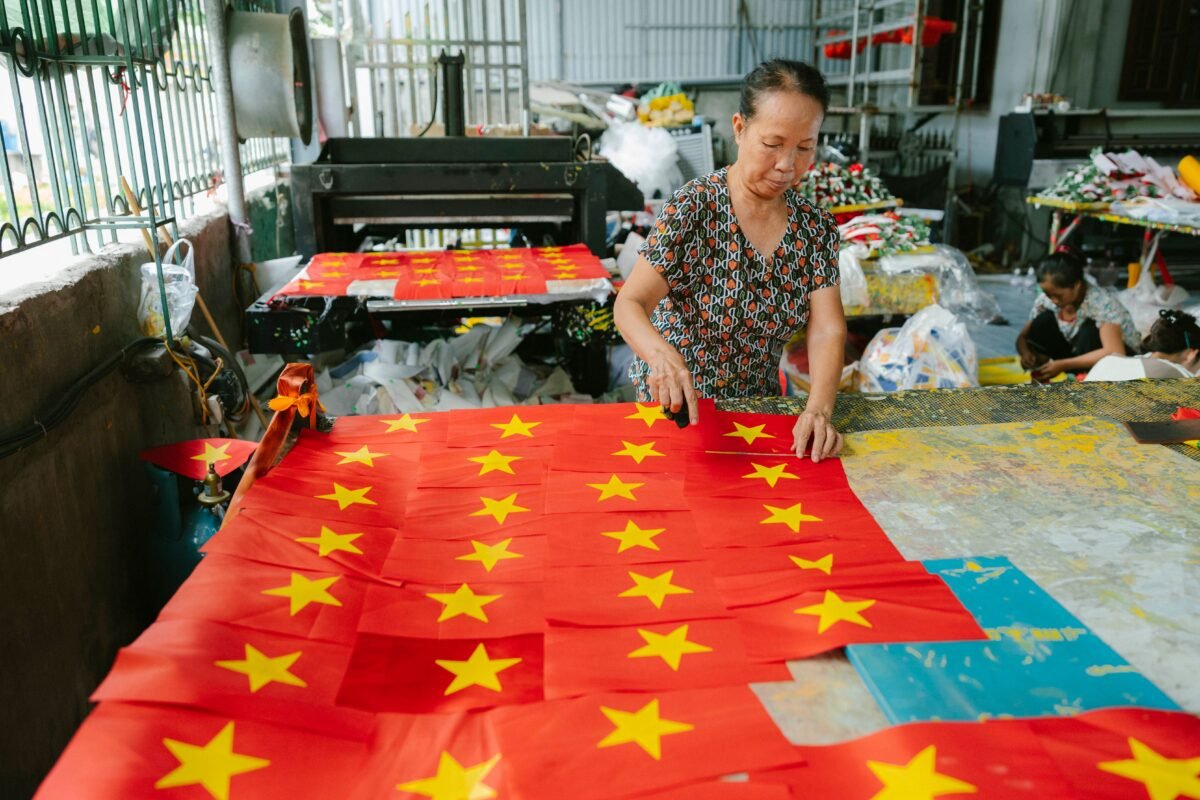
Garments led the China + 1 wave: waves of Chinese sewing plants moved to Vietnam a decade ago. But does the cost math still work as Vietnamese wages rise, fabrics still come from China, and FTA origin rules tighten? This article dissects each cost component of a garment order — so Chinese factory owners know where Vietnam wins and where it loses.
Four components deciding the garment math
1. Labour: still winning, but the margin shrinks
Garments are the most labour-intensive sector — labour dominates unit cost. Vietnamese sewing wages run below China’s, but the gap narrows yearly. Plus: Vietnamese sewers are skilled, productive on basics (T-shirts, jeans) — cost per unit stays competitive. Minus: high-tech, fast-fashion orders need skilled hands — increasingly scarce in southern garment hubs.
2. Fabrics and trims: the Achilles’ heel
Most premium fabrics still come from China — logistics costs, lead times and disruption risks are permanent math. More importantly: for EVFTA/CPTPP tariff benefits, products must meet origin rules (fabric originating in FTA members) — Chinese fabric sewn in Vietnam for the EU may not qualify for 0%. Lesson: moving the sewing plant without moving (or finding) fabric sources is half a move — model fabric + actual tariff costs, not just sewing.
3. Tariffs: the biggest lever — if qualified
Vietnamese garments enter the EU and Japan at FTA-preferential tariffs Chinese goods lack — often the biggest saving, exceeding labour gaps. But “if qualified” is key: garment origin rules are strict (from fabric onward), demanding full traceability. Plants failing origin lose the tariff lever entirely — leaving only cheap labour, which alone doesn’t win.
4. Transition costs: don’t forget the “river-crossing fee”
New plant setup: industrial land, construction, machines, hiring and training hundreds of workers, trial runs — 12–24 months to design productivity. Meanwhile costs burn and customers may be lost to late delivery. Honest math counts total transition cost + lost revenue in the interim, spread over the benefit years — not this month’s wage versus last month’s.
Verdict: when to move?
Move when: key customers are in the EU/Japan/US (FTA benefits), orders are large and stable (spreading transition costs), and origin-qualifying fabric exists (Vietnamese/FDI or FTA-country fabric). Not yet when: small fragmented orders, specialty fabrics only China makes, or customers don’t require Vietnamese origin. Principle: garments win in Vietnam on tariffs + labour — lose either and the math breaks.
The fabric-origin trap most movers discover too late
The single costliest surprise in garment relocation is discovering — after the plant is built — that the tariff advantage was never real. The mechanics: EVFTA and CPTPP garment origin rules generally require production starting from fabric (or even yarn) within the FTA territory. A factory sewing Chinese fabric in Vietnam and shipping to the EU often faces the full MFN duty rate — the “saving” that justified the entire move evaporates. Three ways movers handle this: (a) switch to qualifying fabric sources (Vietnamese mills, Korean/Taiwanese-invested mills in Vietnam, or FTA-member imports) — usually at higher fabric cost that must be netted against tariff savings; (b) use cumulation provisions where the FTA allows it; (c) accept MFN rates and compete on labour alone — rarely viable. The correct sequence is fabric-first: lock origin-qualifying fabric supply before signing the land lease, because a sewing plant without qualifying fabric is just an expensive version of the old cost structure. Diligence the fabric question with a customs/origin specialist, not the sewing contractor — their incentives point in opposite directions. Get the origin ruling in writing before cutting the first purchase order — verbal assurances from a supplier evaporate the moment customs asks questions.
Negotiating with local authorities — the “art” of winning incentives
Preparation before the meeting — never “empty-handed”
(1) Project dossier: total capital, headcount, technology level, expected localisation, projected revenue/exports — localities judge projects on these numbers. (2) Comparisons: know what other localities offer (for leverage) — but don’t flaunt it (localities hate being “squeezed”). (3) Representation: send someone empowered to decide (not staff who must “ask the boss”) — localities respect seriousness.
What’s negotiable — and what isn’t
Negotiable: land rent (within bands), lease term, land-handover timelines, infrastructure support (power, water, roads), recruitment support (labour referrals), fast-track procedures (one-stop). Not (don’t ask): tax holidays beyond the legal framework (localities lack authority), free land (doesn’t exist), unlawful commitments (promised but undeliverable — you bear the consequences).
The “verbal incentive” trap — get it on paper
Localities promise verbally freely (cheap land, stable power, fast procedures) — when unfulfilled, you have no recourse. Rule: every incentive needs writing (investment approval decisions, land leases, commitment letters) — “verbal promise = no promise”. Especially: tax incentives follow tax law (localities can’t decide) — never believe “the province will handle taxes.”
After the handshake — making promises stick
Signed documents still need follow-through. (1) Name a liaison: one dedicated officer on each side (investor + locality) — problems route through people, not offices. (2) Milestone tracking: convert commitments into a timeline with owners (land handover by X, power by Y) — review monthly until delivered. (3) Escalation paths: agree upfront who to call when commitments slip (department director? vice-chairman?) — agreed escalation beats angry surprises. Reality: localities that deliver become your reference for expansion; those that don’t teach you to diversify provinces next time.
Textile China+1 — the old playbook that still works
Textiles led China+1 (since the 2010s) — lessons: (1) early wins (firms arriving 2012–2015 are now deep-rooted — cheap land, stable labour); (2) the chain follows (yarn → weaving → dyeing → sewing — the whole chain moving is efficient, going solo is costly); (3) FTAs (EVFTA, CPTPP — zero duties to EU/Japan — the main reason many moved). Moving now: land pricier, wages higher — but still opportunities (premium niches, technical textiles).
The upgrading imperative — escaping the low-end trap
Late textile movers can’t compete on cost with early arrivals — compete on value: (1) technical textiles (industrial fabrics, higher margins, fewer competitors); (2) speed (fast-fashion responsiveness — Vietnam’s proximity to fabric sources + short lead times); (3) sustainability (EU buyers demanding certified processes — new plants built green from day one outcompete retrofitted old ones); (4) vertical integration (dyeing + sewing together — controlling quality and lead times). Reality: the low-end textile game in Vietnam is crowded — the winners among new entrants are not the cheapest but the most capable.
Garment relocation checklist
(1) Identify key export markets → compute real FTA tariffs (origin-qualified?); (2) check fabric sources: Vietnamese/FDI/FTA-country vs still-Chinese (tariff impact); (3) compare labour cost per unit (not wage per hour); (4) total transition costs (land, plant, machines, hiring, training, trials); (5) estimate at-risk revenue over 12–24 transition months; (6) pick parks near garment clusters (ready sewing labour); (7) IRC under Investment Law 143/2025/QH15. Principle: garment math = tariffs + fabric + labour + transition — miss one variable and it’s wrong.
Contact us
FLAT Law Firm advises Chinese investors in Vietnam across the full lifecycle: investment structuring, IRC/ERC procedures, tax, labour, intellectual property and dispute resolution. Contact us for advice tailored to your case.
This article has been quality-reviewed by the FLAW AI Legal Council
Related articles
- How Long to Set Up in China? Timeline Compared With Vietnam (IRC/ERC)
- Total Landed Cost: Manufacturing in Vietnam vs China for US-Bound Goods
- Scorecard for Chinese Exporters to the US: Vietnam, India or Thailand?
- Will Your Chinese Suppliers Follow You to Vietnam? Supply-Chain Assessment
- Moving Machinery From China to Vietnam: Import Tax and Valuation