
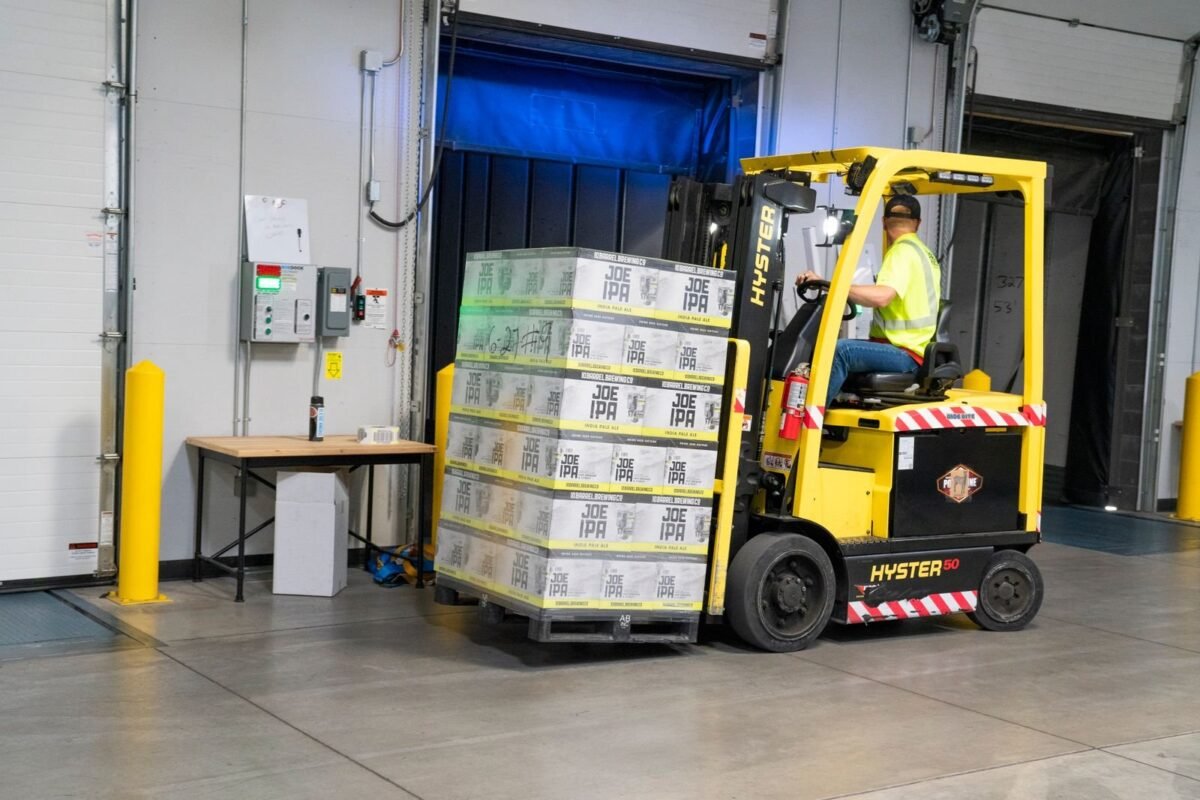
Scenario: a small importer orders from three different suppliers in the same country, each lot only a few cubic metres — not enough to justify a full container. The three suppliers’ goods are consolidated into one shared container (LCL cargo); on arrival in Vietnam the container must be split for each cargo owner at a dedicated facility: a CFS.
What a CFS is: the consolidation site inside the customs system
A CFS (container freight station) in Vietnamese law is a “site for consolidation of less-than-container-load cargo” — a warehouse and yard under customs supervision where LCL cargo is consolidated into shared containers for export, or deconsolidated from a shared container on import for delivery to each cargo owner. Under Clause 3, Article 61 of the Customs Law 54/2014/QH13, goods brought into a consolidation site comprise imported goods that have not yet undergone customs procedures, and exported goods that have completed customs procedures or have a registered declaration with physical inspection to be performed at the site. Goods may be stored at a consolidation site for no more than 90 days from entry, extendable once by up to 90 days for a legitimate reason.
Recognition conditions under Article 19 of Decree 68/2016
Article 19 of Decree 68/2016/ND-CP sets the recognition conditions for a CFS: the site must be located in an area prescribed in Clause 1, Article 62 of the Customs Law; it must have a minimum area of 1,000 square metres (excluding yards and auxiliary works) with fences separating it from surrounding areas; it must provide sufficient working conditions for customs, such as a working place, a goods inspection area, space for installing customs inspection equipment and a storehouse for exhibits as specified by the Ministry of Finance; and it must have software capable of managing receipts, issues and inventory by commodity item, goods buyer and customs declaration, backing up and exporting data for reporting, statistics and archiving, and connecting directly to the managing customs office’s computer network.
Two-way functions: consolidating exports and splitting imports
The import direction is the busiest: an LCL container from abroad is brought intact into the CFS, the operator unpacks it and sorts the goods by each house bill of lading for each cargo owner; every owner (or their agent) clears customs for their portion and collects the goods at the CFS after clearance. The export direction runs in reverse: small shippers deliver LCL cargo that has completed procedures (or has a declaration registered for inspection at the CFS), and the operator consolidates cargo from many shippers on the same route into one shared container under customs supervision; the container is sealed and moved to the port for loading under the master bill of lading combined with the house bills.
In and out procedures: the house bill of lading is the document axis
The documentation axis of LCL cargo is the two-layer bill of lading system: the master bill issued by the carrier or consolidator for the whole container, and the house bill of lading for each component cargo owner. When imports arrive, the consolidator or its agent issues an arrival notice to each owner under the house bill; the owner presents the house bill, an introduction letter or authorisation, and files a customs declaration for its portion like an ordinary import lot (code, value and duty computed on that portion); after clearance, the CFS operator delivers the goods against the delivery order and completed customs documents.
CFS costs at framework level and choosing an operator
CFS charges have no unified state tariff: each operator publishes its own service tariff, usually split into items such as container unpacking or packing fees by volume or weight, storage fees per day after an initial free period, handling fees, documentation service fees, and surcharges for special cargo (refrigerated, dangerous, oversized).
Frequently Asked Questions
1. What is a CFS and when is it used?
A CFS is a site for consolidation of less-than-container-load cargo — a warehouse and yard recognised by customs under the Customs Law and Article 19 of Decree 68/2016/ND-CP, operating under customs supervision to consolidate several LCL lots into one shared container on export, and to split a shared LCL container on import for each cargo owner. It is used when a lot does not fill a full container, or when several owners share one container on the same route. Goods may be stored at a CFS for no more than 90 days, extendable once by up to 90 days.
2. What are the customs procedures at a CFS?
Imports: the LCL container is brought into the CFS, the operator unpacks and sorts the goods by house bill of lading; each cargo owner files a customs declaration for its portion like an ordinary import lot and collects the goods at the CFS after clearance. Exports: the shipper delivers LCL cargo that has completed procedures (or has a declaration registered for inspection at the CFS); the cargo is consolidated and packed into a container under customs supervision and sealed for transfer to the port. The whole process takes place inside the customs-supervised area because the goods are uncleared or in the course of procedures.
3. Roughly how much does CFS storage cost?
There is no unified state tariff: each CFS operator publishes its own tariff, usually comprising container unpacking or packing fees by volume or weight, storage fees per day after an initial free period, handling fees and documentation fees, plus surcharges for refrigerated, dangerous or oversized cargo. At framework level, the cost per cubic metre of LCL cargo is well above full-container transport because many owners are handled within one container; importers should request an all-in quotation through to cargo collection and ask explicitly about surcharges that may arise.
4. Which CFS operator is reputable?
Rather than advertising reputation, check three things: whether the consolidation site appears on the list recognised by customs under Decree 68/2016/ND-CP and is conveniently located relative to the port and the enterprise’s warehouse; whether the tariff is public, all-in and low in extra surcharges; and actual operating capability — unpacking speed, on-time arrival notices, and handling of house bill discrepancies. A consolidator with a stable agent network at the export end is also an important criterion for regular LCL imports.
Related articles
- Imported functional foods: notification or full registration?
- Medical device classification A, B, C, D: what importers must know
- Minimum capital for a foreign-invested hospital in Vietnam
- Conditions for foreign-invested specialist clinics (dental, dermatology…)
- Crypto Money Transfers in Vietnam: Grey Zone & 5 Scams
This legal analysis has been verified against current Vietnamese regulations and cross-border FDI transaction practices by the attorneys at FLAT LAW FIRM.

