
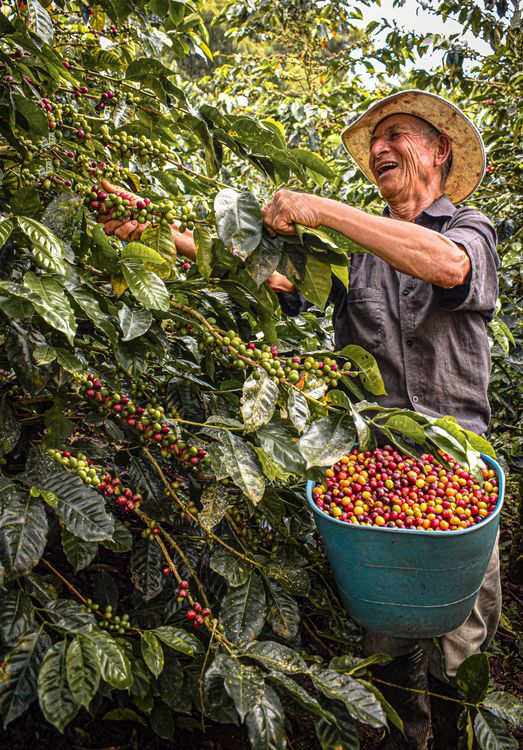
Illustration: coffee harvest, illustrating the Vietnamese coffee supply chain — source: Pexels (free to use).
A real-world scenario: A coffee cooperative in Dak Lak receives an email from its importer in Hamburg: from late 2026, every coffee lot shipped to the EU must come with the GPS coordinates of each production plot, a deforestation-free commitment (no deforestation after 31 December 2020), and a due diligence statement filed in the EU’s system. The importer’s message is blunt: “This is EU law, the obligation is ours — but the data must come from you, and who pays for collecting it… let’s discuss.” For tens of thousands of Vietnamese coffee growers and exporters, the questions are: what exactly is EUDR, who bears the cost, and how do you negotiate fairly?
1. What is EUDR and when does it hit Vietnamese coffee?
EUDR — Regulation (EU) 2023/1115 on deforestation-free supply chains — bans seven commodity groups (coffee, cocoa, soy, palm oil, rubber, wood, cattle) from the EU market unless two things are proven: deforestation-free (production land not deforested after 31 December 2020) and legal (produced in compliance with the laws of the country of production).
The application timeline has been delayed twice. The regulation entered into force on 29 June 2023, was initially to apply from 30 December 2024, was then postponed to 30 December 2025, and on 17 December 2025 the European Parliament approved a second postponement: large and medium enterprises apply from 30 December 2026, micro and small enterprises from 30 June 2027. For Vietnamese coffee — a flagship export to the EU — 30 December 2026 is the date to remember.
2. Whose legal duty is it? The good news and the not-so-good news
The good news: the due diligence duty under Article 6 of EUDR falls on the “operator” — the business placing the product on the EU market, in practice the EU-based importer. Vietnamese businesses, as suppliers, are not directly regulated.
The not-so-good news: to discharge their duty, EU importers must collect three things from the supply chain (Article 9): (a) product description information, (b) geolocation coordinates of all production plots where the coffee was grown, and (c) evidence of legality. They must then file a Due Diligence Statement (DDS) in the EU information system before customs clearance. Without data from Vietnam, the importer cannot file the DDS — and the goods cannot enter the EU.
One important advantage: the European Commission has classified Vietnam as a low-risk country under Regulation (EU) 2025/1093 of 22 May 2025. Goods from low-risk countries benefit from simplified due diligence (Article 13 EUDR): importers need not conduct full risk assessment and mitigation as they would for high-risk countries. But “simplified” does not mean exempt: information collection (Article 9), geolocation, and the DDS filing remain mandatory.
3. Where does the bill land? Three main cost items
In practice, EUDR compliance costs are being pushed down toward Vietnam in three forms:
First, geolocation mapping costs. Every coffee plot must be measured, its coordinates recorded, and cross-checked against deforestation maps. For smallholder farmers (plots under the 4-hectare EUDR threshold), the per-farm cost is modest, but aggregated across thousands of households in one cooperative it becomes significant — not counting the effort of persuading farmers to share land data.
Second, segregation and traceability costs. EUDR requires traceability to each plot. The common Central Highlands model — coffee bought in bulk from many households and mixed at collection agents — does not meet this requirement. Exporters must invest in segregation systems: separate storage, lot codes, and documentation tracking from farm gate to export container.
Third, certification and independent verification costs. Although EUDR does not mandate third-party certification, many EU importers demand it to reduce their own risk — and the cost is typically “suggested” to the Vietnamese side.
4. Negotiating cost allocation: four levers for the Vietnamese side
Since the law does not say who pays, everything depends on contract negotiation. Vietnamese businesses hold four levers:
- Price the compliance cost into the sale. Calculate mapping and segregation costs per kilogram and add them to the FOB price — transparently and with a documented basis, instead of absorbing them silently.
- A compliance cost-sharing clause. Agree explicitly: the importer co-funds the initial mapping investment (usually a one-off), while the Vietnamese side bears the ongoing traceability system’s running costs.
- Long-term offtake commitments in exchange for compliance investment. Once a traceability system is built, demand a 2–3 year framework contract to amortize the cost — avoiding the trap of investing and then losing the buyer to another supplier.
- Leverage the “low-risk” status. Vietnam is a low-risk country — due diligence for Vietnamese goods costs less than for high-risk origins. That is a competitive advantage to negotiate better prices, not a reason to accept bearing the entire cost.
The information in this article is general reference on the law as of the date of writing (18 October 2026) and does not replace legal advice for any specific case.
Frequently asked questions
1. Must a small Vietnamese business file the DDS itself?
No. The DDS filing duty belongs to the EU importer (operator). The Vietnamese side only needs to supply the data (coordinates, legality evidence) as required by contract. However, without that data the goods will not qualify for EU entry.
2. As a “low-risk” country, is Vietnam exempt from due diligence?
No. Low risk only grants simplified procedures (no full risk assessment and mitigation), but information collection, geolocation, and the DDS filing remain mandatory.
3. How does the 31 December 2020 cut-off apply to long-established coffee gardens?
If the land was already coffee farmland before 31 December 2020 with no deforestation after that date, the lot meets the “deforestation-free” condition. The challenge is proving it with coordinates and map data — which is exactly why mapping is needed.
4. What happens if plot coordinates cannot be provided?
The EU importer cannot complete the due diligence file and file the DDS, and the goods will not clear EU customs. In practice, the buyer will switch to a supplier who can comply.
5. Does EUDR require third-party certification?
No. EUDR only requires due diligence and the operator’s DDS. But many importers impose additional certification requirements to manage their own risk — that is a commercial demand, and it can be negotiated.
This article has been quality-reviewed by the FLAW AI Legal Council