
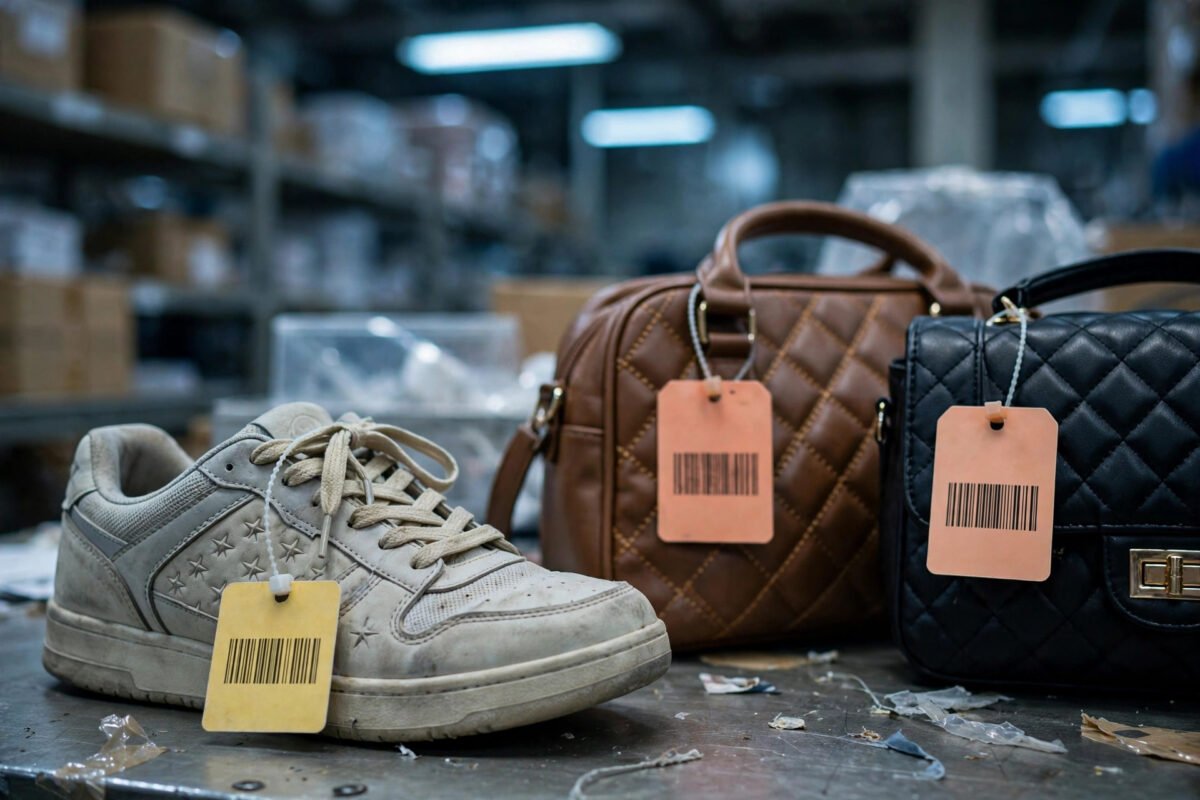
Counterfeit goods are not only a consumer-protection issue. For manufacturers and traders, each seized batch of counterfeit goods may end with an administrative fine — or open a criminal case carrying up to 15 years of imprisonment. Where is the line? This article analyses the definition of “counterfeit goods” under Decree 98/2020/ND-CP, administrative fine levels, and the criminal threshold under Article 192 of the Penal Code (updated by Law 86/2025/QH15, effective 1 July 2025).
1. What counts as counterfeit goods under the law?
Clause 7, Article 3 of Decree 98/2020/ND-CP lists six groups of goods treated as counterfeit:
- (a) Goods with no use value or function, or whose use value or function does not match their origin, name, or the manufacturer’s declared specifications;
- (b) Goods with at least one basic quality indicator or technical characteristic reaching 70% or less of the minimum level in the applicable technical regulation, registered or declared quality standard, or as printed on the label;
- (c) Counterfeit medicines (Clause 33, Article 2 of the Pharmacy Law 2016) and counterfeit medicinal materials (Clause 34, Article 2 of the Pharmacy Law 2016);
- (d) Veterinary drugs or plant-protection products lacking active ingredients, missing registered active ingredients, containing different active ingredients from the label, or with active-ingredient content at 70% or less;
- (dd) Goods with counterfeit goods labels or packaging: fake manufacturer name or address, fake circulation registration or declaration numbers, fake barcodes, fake origin;
- (e) Counterfeit stamps, labels and packaging of goods.
2. Counterfeit vs substandard vs goods of unknown origin

- Counterfeit goods: falling into one of the six groups above — subject to heavy administrative fines or criminal prosecution.
- Substandard goods: quality indicators below the declared standard but above 70% of the minimum — not counterfeit; handled under goods-quality regulations.
- Genuine goods bearing fake labels (e.g. authentic products relabelled with another brand): not Article 192 but potentially the crime of infringing industrial property rights under Article 226 of the Penal Code.
3. Administrative fines for manufacturing and trading counterfeit goods
Decree 98/2020/ND-CP (amended by Decree 17/2022/ND-CP and Decree 24/2025/ND-CP) provides:
- Trading counterfeit goods in terms of use value or function (Article 9): fines of VND 1–70 million for individuals;
- Manufacturing counterfeit goods (Article 10): fines of VND 5–100 million for individuals;
- Counterfeiting goods labels or packaging (Article 11): fines of VND 1–50 million for individuals;
- Manufacturing or trading counterfeit stamps, labels and packaging (Articles 12, 13, 14): corresponding fine brackets.
Organisations are fined twice the individual level; the maximum fine for counterfeit-goods violations is VND 200 million (individuals) / VND 400 million (organisations) — Clause 4, Article 4 (amended by Decree 17/2022). Additional sanctions may include confiscation of exhibits, mandatory destruction or recall of goods, and disgorgement of illegal profits.
4. When does it become a criminal offence?

The administrative-to-criminal boundary is the VND 30 million threshold: counterfeit goods worth VND 30 million to under VND 150 million (valued as the equivalent genuine goods) may trigger Clause 1, Article 192. Key points:
- The VND 30 million threshold is calculated on the value of the equivalent genuine goods, not the actual sale price of the counterfeit goods;
- Below VND 30 million, criminal liability still applies if the offender has already been administratively sanctioned for the same conduct or has a prior conviction for the offences in Articles 188–196 or 200 of the Penal Code and reoffends.
Counterfeit food, medicines or fertilisers fall under separate articles (193, 194, 195) with heavier frames — see section 6.
5. Article 192 Penal Code penalties (updated from 1 July 2025)
Article 192 of Penal Code 100/2015/QH13 was amended by Clause 8, Article 1 of Law 86/2025/QH15 (effective 1 July 2025):
- Clause 1: a fine of VND 200 million – 2 billion or 1–5 years’ imprisonment — counterfeit goods worth VND 30 million to under VND 150 million; or under VND 30 million with a prior administrative sanction/conviction; causing 31–60% bodily injury; illegal profits of VND 50 to under 100 million; property damage of VND 100 to under 500 million;
- Clause 2: 5–10 years’ imprisonment — committed by an organised group; on a professional basis; abusing position, power or the name of an agency; goods worth VND 150 to under 500 million; illegal profits of VND 100 to under 500 million; causing death; bodily injury of 61% or more; property damage of VND 500 million to under 1.5 billion;
- Clause 3: 7–15 years’ imprisonment — goods worth VND 500 million or more; illegal profits of VND 500 million or more; causing death of two or more persons; total bodily injury of 122% or more; property damage of VND 1.5 billion or more;
- Clause 4 (additional penalties): a fine of VND 40–100 million, prohibition from holding positions or practising for 1–5 years, confiscation of part or all of assets;
- Clause 5 (legal entities): fines of VND 2–6 billion (Clause 1 offences) / VND 6–12 billion (Clause 2) / VND 12–18 billion or suspension of operations for 6 months – 3 years (Clause 3); permanent suspension under Article 79; additional fines of VND 100–400 million and bans on business activities or capital mobilisation for 1–3 years.
Note: Law 86/2025 doubled the monetary fines (from a maximum of VND 1 billion to VND 2 billion) but kept the quantitative thresholds of VND 30/150/500 million unchanged. Articles written from the draft law proposing higher thresholds are inaccurate.
6. Counterfeit food, medicines and fertilisers: separate offences
- Article 193 — counterfeit foodstuffs, food and food additives: 2–5 years’ (Clause 1) up to life imprisonment (Clause 4);
- Article 194 — counterfeit curative or preventive medicines: the death penalty was abolished from 1 July 2025; the highest frame is now life imprisonment;
- Article 195 — counterfeit animal feed, fertilisers, veterinary drugs, plant-protection products, plant varieties and animal breeds.
Counterfeit food or medicines are charged under these separate articles, not Article 192.
7. How are companies (legal entities) punished?
A commercial legal entity committing counterfeit-goods offences faces Clause 5, Article 192: fines from VND 2 billion to VND 18 billion depending on the frame, possible temporary or permanent suspension of operations, plus additional bans on business and capital mobilisation. The legal representative and the individuals directly carrying out the conduct may still face criminal liability as individuals.
8. What to do if an inspection record is drawn up against you?
- Read the record carefully before signing; note any disagreement in the record itself;
- Collect and keep invoices and documents proving the origin of the goods;
- Where quality is disputed, request an expert assessment;
- You have the right to complain against an administrative sanction decision or to bring an administrative lawsuit;
- If the case shows criminal signs, consult a lawyer from the earliest stage.
Further reading
The information above is for reference only and does not constitute legal advice.
For reference only, not legal advice. Content quality-checked by the AI Legal Council; not yet reviewed by a human lawyer.